The House of Wisdom was a library, translation centre, and place of learning in Baghdad, the capital of the Abbasid Caliphate. In Arabic it was called Bayt al-Hikma. At its height, in the 800s, it was the centre of a great project to collect the knowledge of the ancient world, translate it into Arabic, and build on it. The work done there shaped medicine, mathematics, astronomy, and philosophy for centuries, and much of it later reached Europe.
When and where it began
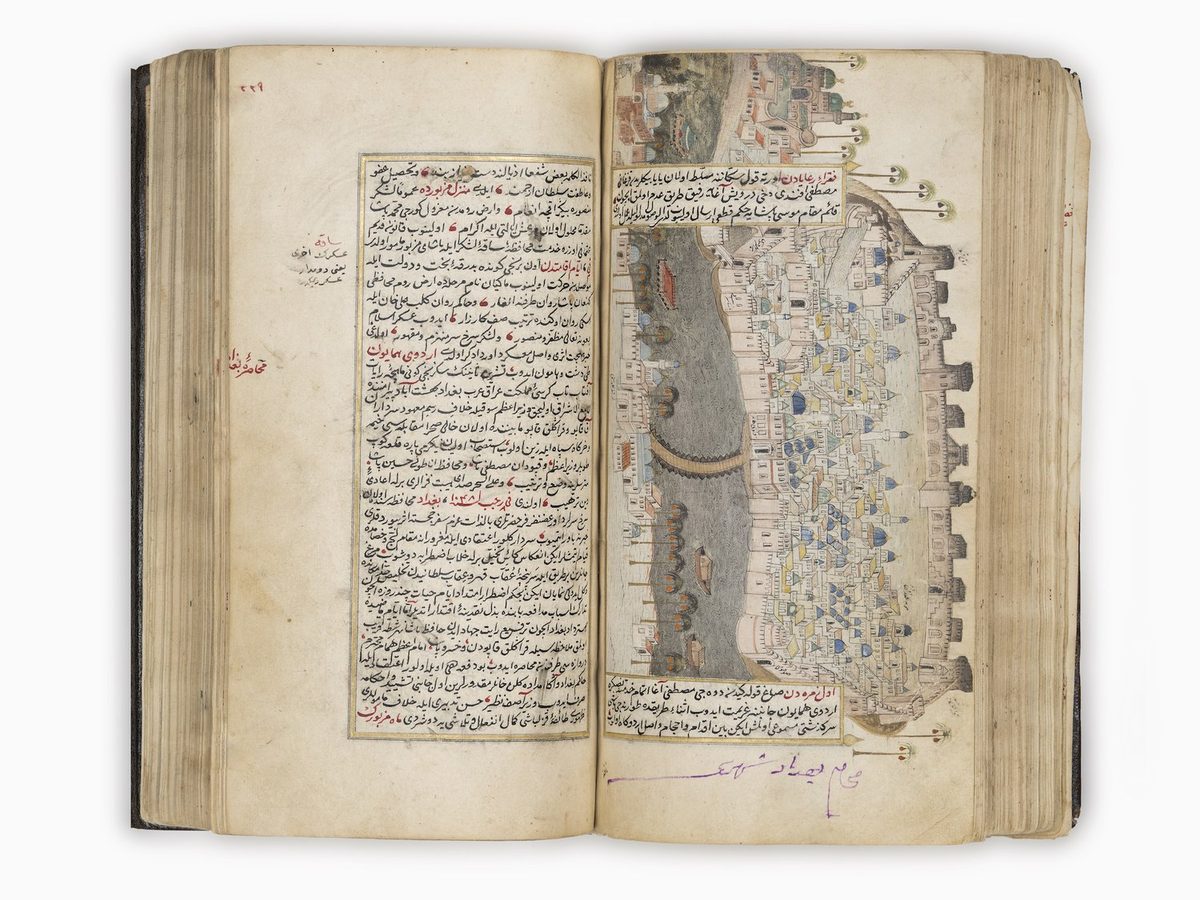
Baghdad was founded in 762 by the caliph al-Mansur as the new capital of the Abbasid Caliphate. It was built as a round city on the river Tigris, and it quickly became one of the largest and richest cities in the world, filled with markets, mosques, and palaces.
The House of Wisdom grew out of the caliphs' interest in learning. The caliph Harun al-Rashid, who ruled from 786 to 809, collected books and supported scholars. His son al-Mamun, who ruled from 813 to 833, turned it into a major institution. He sent agents to Constantinople and other places to buy or copy Greek manuscripts, and he paid translators well. The story is told that some were paid in gold equal to the weight of the books they translated.
There is debate among historians about what the House of Wisdom was in exact terms. It was probably not a single building with one purpose, but a group of libraries, translation workshops, and meeting places, some of them inside the caliph's palace. What is clear is that in the 800s, Baghdad had an organised, state-supported effort to translate and study the knowledge of the ancient world, and the House of Wisdom was its heart.
The great translation movement
The main work of the House of Wisdom was translation. Scholars translated books from Greek, Persian, Syriac, and Sanskrit into Arabic. They worked on the writings of Aristotle and Plato, the medical works of Hippocrates and Galen, the geometry of Euclid, the astronomy of Ptolemy, and the mathematics of India and Persia.
The most famous translator was Hunayn ibn Ishaq, a Christian scholar from al-Hira who lived from about 809 to 873. He knew Greek, Syriac, and Arabic, and he translated more than a hundred medical and scientific works, including almost all of Galen's writings. He also trained a school of translators, and their translations were careful and exact. They created new Arabic words for Greek scientific terms, building the language of science in Arabic.
Translation was not just copying. The scholars checked the texts against each other, corrected mistakes, and added their own notes. They tested the ideas they read. A doctor reading Galen might compare his claims with what he saw in patients, and an astronomer reading Ptolemy might check his star tables against the sky. This habit of testing and questioning is one of the reasons the work of Baghdad went beyond the books it translated.
What the scholars produced
The House of Wisdom was not only a place for translation. Its scholars wrote new works of their own, and some of these are among the most important books in the history of science.
The most famous is Muhammad ibn Musa al-Khwarizmi, who worked in Baghdad in the 800s. His book on algebra, written around 825, gave the subject its name. The word algebra comes from al-jabr, part of the book's Arabic title. His name also gave us the word algorithm. In the same period, he worked on Indian numerals, the number system we use today, and wrote a book explaining how to use them. He also made maps and tables for the caliph, and worked on astronomy.
In medicine, the Persian scholar al-Razi, known in Europe as Rhazes, wrote a large medical encyclopedia and a book on smallpox and measles that was used in Europe for centuries. Later, Ibn Sina, known as Avicenna, wrote the Canon of Medicine, a standard textbook in European universities until the 1700s. Both men built on the Greek medical texts translated in Baghdad, but they added their own observations.
In astronomy, scholars in Baghdad built observatories and made new measurements of the stars and planets. They improved the astrolabe, the instrument used to find the time and to navigate. In philosophy, al-Kindi, called the philosopher of the Arabs, wrote on Greek thought and tried to bring it together with Islamic belief. His work was later translated into Latin and read in Europe.
The scholars of Baghdad also worked in other fields. Ibn al-Haytham, known as Alhazen, wrote a book on light and vision that changed how scientists thought about the eye. They improved methods for making glass, paper, and medicines. Paper, which had come to the Muslim world from China, was made in Baghdad from the 700s, and it made books cheaper and more common.
Who worked there
The House of Wisdom brought together people from many backgrounds. Muslims, Christians, and Jews worked side by side, and scholars came from Persia, Central Asia, Iraq, and Syria. Many of the translators were Christians who knew Syriac and Greek, while many of the writers were Persian. The common language was Arabic, and the work was paid for by the caliph and by wealthy patrons.
This mix of people was normal for Baghdad, a meeting place for traders and scholars from across Asia. The House of Wisdom was part of that open culture, and it is one reason why its work drew on so many traditions at once.
How it ended
The House of Wisdom did not end at one moment, but it faded as Baghdad's power faded. In the 900s, the Abbasid caliphs lost control of much of their empire, and Baghdad became less rich and less safe. Scholars moved to other cities, such as Cairo and Cordoba. Translation and learning continued in the Muslim world, but Baghdad was no longer the centre.
The famous end came in 1258, when the Mongols under Hulagu Khan sacked Baghdad. The city was destroyed, the caliph was killed, and libraries were burned or thrown into the river Tigris. Later writers said that the river ran black with ink from the books. The story is probably an exaggeration, but it captures the scale of the loss. Much of what had been collected in Baghdad was lost, and the city never recovered its old place as a centre of learning.
Why the House of Wisdom still matters
The work of the House of Wisdom survived in two ways. First, the Arabic books it produced spread across the Muslim world, from Spain to India, and were copied and studied for centuries. Second, from the 1100s onwards, many of those books were translated from Arabic into Latin in Spain and Sicily, and they reached the new universities of Europe. European scholars read al-Khwarizmi on algebra, Ibn Sina on medicine, and Aristotle in Arabic translations with Arabic commentaries. In this way, the learning of Baghdad passed into Europe, and from there into modern science.
The House of Wisdom is also remembered as an example of what a society can do when it values learning. A caliph paid for books and translators, scholars from many faiths worked together, and knowledge from Greece, Persia, and India was brought into one language. The Golden Age of Islam, which lasted roughly from the 700s to the 1200s, had its centre in Baghdad, and the House of Wisdom was the clearest sign of it.
Frequently asked questions
What was the House of Wisdom?
The House of Wisdom, or Bayt al-Hikma, was a library and translation centre in Baghdad during the Abbasid Caliphate. Scholars there translated Greek, Persian, and Indian works into Arabic and wrote new books on mathematics, medicine, astronomy, and philosophy.
Who founded the House of Wisdom?
It grew under the caliphs Harun al-Rashid and his son al-Mamun, who ruled from 813 to 833. Al-Mamun made it a major state-supported institution and paid translators to bring Greek manuscripts to Baghdad.
What did the House of Wisdom produce?
Its scholars produced the first books on algebra, written by al-Khwarizmi, and major works on medicine, astronomy, optics, and philosophy. They also translated the works of Aristotle, Galen, Euclid, and Ptolemy into Arabic.
Was the House of Wisdom destroyed?
Baghdad was sacked by the Mongols in 1258, and its libraries were destroyed or thrown into the river Tigris. By then, the House of Wisdom had already faded as the Abbasid Caliphate lost power, but the Mongol sack ended Baghdad's role as a centre of learning.
Why is the House of Wisdom important today?
The books translated and written in Baghdad passed into Europe through Latin translations made in Spain and Sicily, and they shaped European science for centuries. The House of Wisdom is remembered as the heart of the Golden Age of Islam.