Al-Biruni was a Persian scholar who lived a thousand years ago and is remembered as one of the greatest minds of the medieval world. In a single lifetime, he wrote about astronomy, mathematics, geography, history, languages and religion. He measured the size of the Earth with remarkable accuracy, wrote the first detailed study of India by a foreign scholar, and discussed the idea that the Earth might spin on its own axis, centuries before it became accepted in Europe.
His full name was Abu Rayhan Muhammad ibn Ahmad al-Biruni. He was born in 973 in Kath, the capital of the region of Khwarezm, in what is now Uzbekistan. He died in 1048 in Ghazni, in what is now Afghanistan, at the age of about 75.
A life of travel and study
Al-Biruni grew up in a world of small kingdoms and shifting borders. Khwarezm was ruled by a local dynasty, and when that dynasty fell, Al-Biruni left and travelled from court to court, offering his learning to rulers who would support him. He worked in Rayy, in modern Iran, then returned to Khwarezm, and later joined the court of Mahmud of Ghazni, the powerful ruler of an empire that stretched from Persia to northern India.
Al-Biruni was a traveller as well as a scholar. He travelled with Mahmud's armies into India, where he spent years learning Sanskrit, studying Hindu religion and science, and talking to Indian scholars. He also knew Arabic, Persian and his native Khwarezmian, and he had some knowledge of Greek, Hebrew and Syriac. This command of languages let him read the science of many cultures and compare them.
He was a careful and honest scholar. He often wrote that he did not know something rather than guessing, and he criticised other writers when their figures did not match what he had measured himself. He wrote about 146 works, of which around 103 are known today, though only a part of them survive in full.
Measuring the Earth
Al-Biruni's most famous achievement was his measurement of the Earth's circumference. Using a mountain in India, he measured the angle to the horizon from the top of the peak and combined it with the height of the mountain, which he had measured with care. From this, he worked out the radius of the Earth. His figure was about 6,339 kilometres, very close to the modern value of about 6,371 kilometres at the equator. For a scholar working without telescopes or modern instruments, it was an extraordinary result.
He also worked on the density of minerals and metals. He built a simple instrument to measure how much water a piece of metal displaced, and used it to work out the specific gravity of gold, silver, lead and precious stones. His figures were accurate enough that jewellers could use them to tell real gems from fakes.
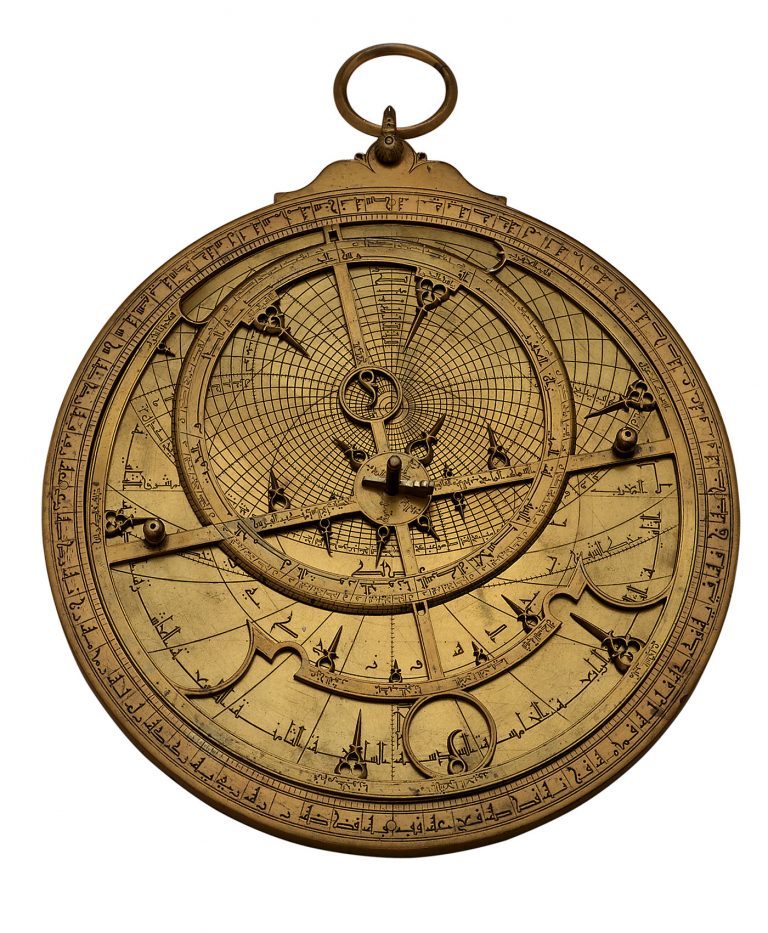
In astronomy, Al-Biruni wrote about the astrolabe, the brass instrument used to tell the time and find the direction of prayer. He improved its design and wrote a detailed guide to its use. He studied the movements of the Sun, Moon and planets, and he wrote about eclipses, the calendar and the geography of the Earth. He also discussed the idea that the Earth rotates on its axis, an idea that was not accepted in his time, and he wrote that he could neither prove nor disprove it, which was an honest answer for a scholar of his age.
The Book of India
Al-Biruni's most important book is the Kitab al-Hind, usually translated as The Book of India. He wrote it in Arabic in about 1030, after years of study in India. It is a detailed account of Indian religion, philosophy, science, customs, law and daily life.
What makes the book remarkable is its method. Al-Biruni did not simply describe India from the outside. He learned Sanskrit, read Indian texts, and quoted Indian scholars in their own words. He compared Hindu ideas with Greek, Persian and Islamic thought, and he tried to be fair to the beliefs he described, even when he disagreed with them. He wrote that a scholar should report what people believe, not attack them for it. For this reason, modern historians call him one of the first scholars of comparative religion.
The book also contains his work on Indian astronomy and mathematics. He noted that Indian scholars had used the number zero and the decimal system, and he helped to spread these ideas in the Islamic world. He also recorded the geography of India, its rivers, cities and trade routes, and its history as far as he could learn it.
Other works and ideas
Al-Biruni wrote on many subjects. His book on the remaining signs of past centuries, known as The Chronology of Ancient Nations, is a history of calendars and festivals in many cultures, from the Persians and Greeks to the Jews, Christians and Hindus. His book on minerals and gems, the Kitab al-Jawahir, describes stones, metals and their properties in detail.
He also wrote about the shape of the Earth and the distribution of land and sea. He argued that there might be unknown lands on the other side of the globe, in the southern hemisphere, and he drew maps showing the known world. Some of his ideas about the Earth and its motions were far ahead of his time.
Al-Biruni was not only a scientist. He wrote about religion with an open mind. In his books, he compared the beliefs of different peoples and tried to understand them on their own terms. He criticised superstition, including astrology as fortune telling, while keeping astronomy as a science. He believed that reason and observation were the way to knowledge, and he trusted measurement over tradition.
His legacy
Al-Biruni died in Ghazni in 1048. His influence lasted long after his death. His books were copied and read across the Islamic world, and some were later translated into Latin and other languages. Modern scholars regard him as one of the greatest scientists of the medieval period, and he is often placed alongside his near contemporary Ibn Sina, known in the West as Avicenna.
His name is remembered in many ways. A crater on the Moon is named Biruni after him. Universities and institutes in Uzbekistan, Iran and other countries carry his name. In Uzbekistan, his birthplace is celebrated as a national hero, and his work is studied as part of the country's history.
Al-Biruni's life shows what a single scholar could achieve a thousand years ago with curiosity, patience and careful measurement. He crossed the borders of language, religion and culture, and he wrote down what he found with honesty. That is why he is still read today.
Frequently asked questions
Who was Al-Biruni?
Al-Biruni (973-1048) was a Persian scholar from Khwarezm, in modern Uzbekistan. He was a polymath who wrote about astronomy, mathematics, geography, history, languages and religion, and he is remembered as one of the greatest minds of the medieval Islamic world.
What is Al-Biruni famous for?
He is famous for measuring the Earth's circumference with great accuracy, for his book on India, the Kitab al-Hind, and for his work on astronomy, the astrolabe and the density of minerals and metals.
How did Al-Biruni measure the Earth?
He measured the angle to the horizon from the top of a mountain in India and combined it with the height of the mountain. From these two figures, he worked out the Earth's radius at about 6,339 kilometres, very close to the modern value of about 6,371 kilometres.
What is the Kitab al-Hind?
The Kitab al-Hind, or The Book of India, is Al-Biruni's study of Indian religion, science, customs and daily life, written in about 1030. He learned Sanskrit and quoted Indian scholars directly, and the book is known for its fair and careful method.
Where was Al-Biruni born and where did he die?
He was born in 973 in Kath, the capital of Khwarezm, in what is now Uzbekistan. He died in 1048 in Ghazni, in what is now Afghanistan, at the court of the Ghaznavid rulers.