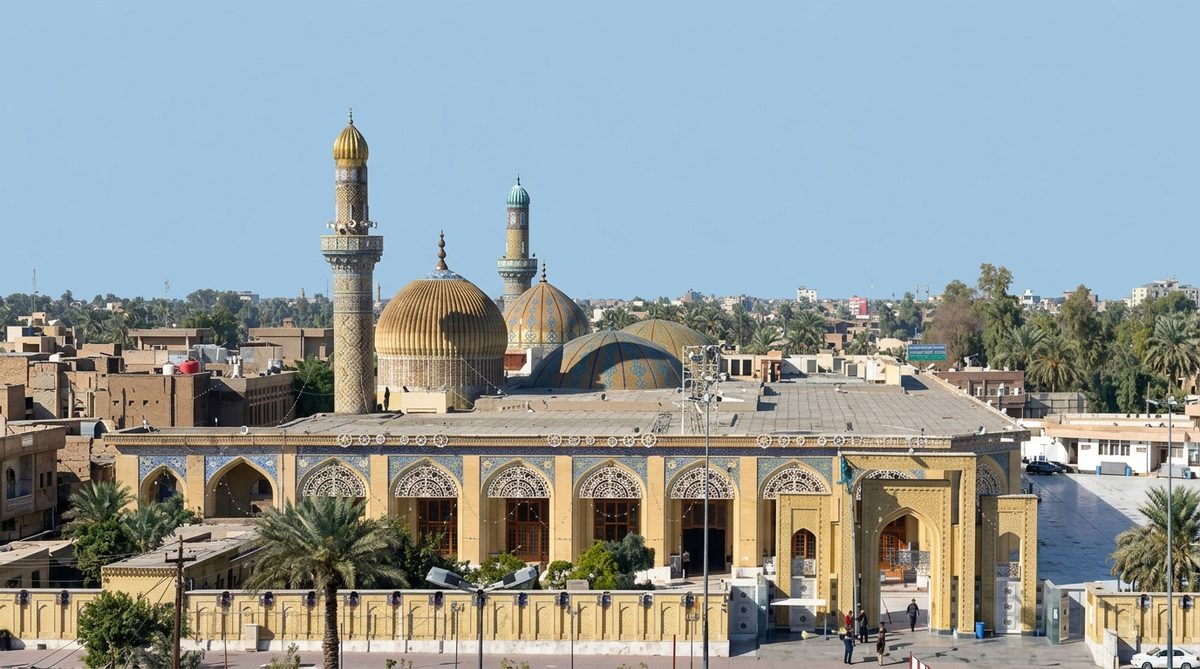
Imam Abu Hanifa was one of the most important scholars in the history of Islam. Born in 699 CE in Kufa, in what is now Iraq, he founded the Hanafi school of Islamic law, which is today the most widely followed legal school in Sunni Islam. Millions of Muslims in Turkey, Central Asia, South Asia, the Balkans and the Arab world follow his teachings. He was a merchant by trade, a teacher by choice, and a man who refused to bend his principles for a caliph.
His full name was al-Numan ibn Thabit ibn Zuta, but he is known by his nickname, Abu Hanifa, which means "father of Hanifa", after his daughter. He lived from 699 to 767 CE, during the late Umayyad period and the early Abbasid period, a time when Islamic law was still taking shape.
A merchant from Kufa
Abu Hanifa was born in Kufa, a city in Iraq that was one of the great centres of learning in the early Muslim world. His family was of Persian origin, and his grandfather had become Muslim. His father was a silk merchant, and Abu Hanifa followed him into the trade. He sold cloth in the markets of Kufa, and he was known as an honest trader who dealt fairly with his customers.
As a young man, he was more interested in debate than in trade. Kufa was full of scholars and lively arguments about law, theology and the meaning of the Quran and the sayings of the Prophet Muhammad. Abu Hanifa took part in these debates, and his skill soon became clear. He studied with the leading scholar of Kufa, Hammad ibn Abi Sulayman, for about eighteen years. When Hammad died, Abu Hanifa took his place as the leading teacher in the city.
He was not a man who simply repeated what he had heard. He asked questions, tested arguments and thought carefully about each problem. His students said he would spend a whole night thinking about a single legal question. He believed that a scholar must use reason, and that the law must work for real people in real situations.
The method of Abu Hanifa
Abu Hanifa's approach to Islamic law was built on clear sources in a clear order. First came the Quran. Then came the sayings and practice of the Prophet Muhammad, known as the Sunnah. Then came the agreement of the early Muslim community, and the practice of the Companions of the Prophet who lived in Kufa.
Where these sources did not give a direct answer, Abu Hanifa used reason. He used analogy, known as qiyas, which means applying the ruling of a known case to a new case that shares the same cause. He also used juristic preference, known as istihsan, which means choosing the ruling that best serves justice and the public good, even when a strict analogy would point the other way.
This use of reason made him famous and also brought him criticism. Some scholars of his time, above all in Medina, said that he relied too much on his own opinion. His defenders answered that he used reason only where the texts were silent, and that his method was careful and disciplined. The debate between the scholars of Iraq, who used reason, and the scholars of the Hijaz, who relied more on transmitted reports, shaped Islamic law for centuries.
Abu Hanifa was also known for his caution. He is reported to have said that he would rather be wrong in declaring something forbidden than wrong in declaring it allowed. He taught his students to think for themselves, and he told them that if they found a stronger proof than his, they should follow the proof, not him.
Students and the Hanafi school
Abu Hanifa's teaching spread through his students, above all two men: Abu Yusuf and Muhammad al-Shaybani. Abu Yusuf became the chief judge of the Abbasid caliph Harun al-Rashid, and he put Hanafi law into practice in the courts of the empire. Muhammad al-Shaybani wrote down the teachings of the school in books that became the foundation of Hanafi law.
Through these students, the Hanafi school spread across the Muslim world. It became the official school of the Abbasid caliphate, then of the Seljuk Turks, then of the Ottoman Empire, which carried it from the Balkans to Egypt and Arabia. It also spread east to Central Asia and India, where the Mughal emperors followed it. Today, the Hanafi school is followed by more Muslims than any other Sunni school, above all in Turkey, Central Asia, Pakistan, India, Bangladesh, the Balkans and parts of the Arab world.
Abu Hanifa himself wrote little. Two short works are linked to his name: Al-Fiqh al-Akbar, a short book on belief, and a collection of hadith known as his Musnad. His real legacy is the school he built through his teaching and his students.
Standing up to the caliph
Abu Hanifa is remembered not only as a scholar but as a man of principle. The Abbasid caliph al-Mansur, who founded Baghdad, wanted him to become the chief judge of the empire. Abu Hanifa refused. He said he was not fit for the post, and he did not want to be part of a government whose actions he could not approve. Al-Mansur was angry, and according to the reports of his students, Abu Hanifa was beaten and imprisoned for his refusal.
He died in Baghdad in 767 CE, at the age of about 68. Some accounts say he died in prison, and some say he was poisoned. What is certain is that he died soon after his clash with the caliph, and that he is remembered as a scholar who would not sell his learning for a post.
His tomb in Baghdad became a place of respect and pilgrimage. A mosque grew up around it, the Abu Hanifa Mosque, which still stands today in the Adhamiyah district of Baghdad. It is one of the most important mosques in Iraq, and its golden dome is a landmark of the city.
Why Abu Hanifa still matters
More than twelve centuries after his death, Abu Hanifa's school is still followed by hundreds of millions of Muslims. His method, which joined the Quran and the Sunnah with reason, analogy and a concern for the public good, shaped the way Islamic law developed. His refusal to serve a ruler he did not trust became a model for scholars who wanted to keep their independence.
Abu Hanifa was a merchant, a teacher and a scholar who built a school of law that outlasted empires. He is remembered in the words of his students: a man who thought deeply, spoke carefully, and never let power buy his opinion.
Frequently asked questions
When did Imam Abu Hanifa live?
Imam Abu Hanifa lived from 699 to 767 CE, which is 80 to 150 AH in the Islamic calendar. He was born in Kufa, in Iraq, and died in Baghdad.
What is the Hanafi school?
The Hanafi school is a school of Islamic law founded on the teachings of Abu Hanifa. It is the most widely followed school in Sunni Islam, and it is the main school in Turkey, Central Asia, South Asia and the Balkans.
Why is Abu Hanifa called the Imam al-Azam?
Abu Hanifa is often called Imam al-Azam, which means "the greatest imam". The title reflects his standing as the founder of the first of the four Sunni schools of law and the depth of his scholarship.
What books did Abu Hanifa write?
Abu Hanifa wrote little himself. Two short works are linked to his name, Al-Fiqh al-Akbar on belief and a collection of hadith known as his Musnad. His teachings were mainly written down by his students, above all Muhammad al-Shaybani.
Where is Abu Hanifa buried?
Abu Hanifa is buried in Baghdad, in the Adhamiyah district. The Abu Hanifa Mosque was built around his tomb, and it remains one of the most important mosques in Iraq.