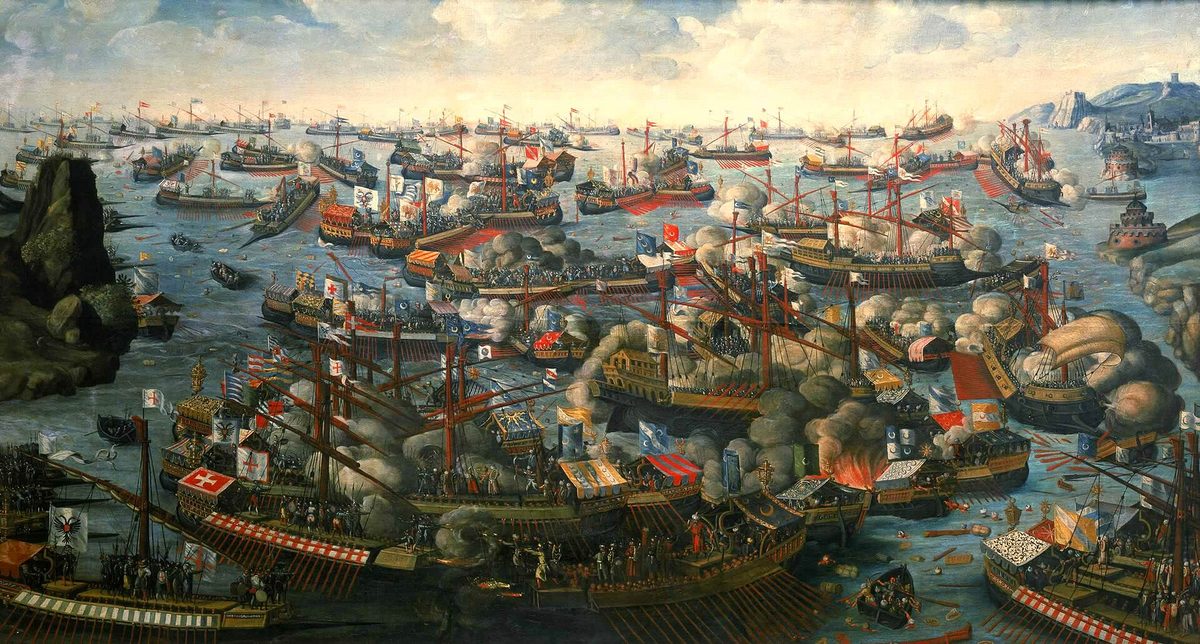
On 7 October 1571, off the coast of Greece near the town of Lepanto, the largest naval battle of the 16th century was fought. A Christian fleet called the Holy League met the Ottoman navy in the Gulf of Patras. After five hours of close fighting, the Holy League won a clear victory, destroying most of the Ottoman fleet. The battle did not end the Ottoman Empire, but it ended the fear that Ottoman ships could not be beaten at sea, and it stopped Ottoman expansion in the western Mediterranean.
What happened at Lepanto
The battle took place at the entrance to the Gulf of Patras, on the western coast of Greece. The Ottoman fleet had about 230 to 250 galleys, the long, oar-powered warships of the time, and around 60,000 to 70,000 men. The Holy League had about 210 galleys and 28,000 soldiers, plus sailors and rowers, making a total force of roughly 80,000 men.
The two fleets formed long lines facing each other. The Holy League placed six large Venetian galleasses, heavy ships armed with many guns, in front of its line. When the fleets met, the galleasses fired first and broke up the Ottoman formation. Then the galleys closed in, and the battle turned into hundreds of small fights between ships locked together.
The fighting lasted from late morning until the afternoon. The Ottoman commander, Ali Pasha, was killed, and his flagship was captured. On the Ottoman left wing, Uluj Ali broke through and escaped with about 30 ships, but the rest of the fleet was lost. The Ottomans lost around 200 ships and about 20,000 to 30,000 men killed, with thousands more taken prisoner. The Holy League lost about 13 ships and around 7,500 men. About 12,000 Christian galley slaves, who had been chained to the Ottoman oars, were freed.
Who fought on each side
The Holy League was an alliance put together by Pope Pius V. Its main members were Spain, the Republic of Venice, the Papal States, and the Italian states of Genoa, Savoy, and Malta. The overall commander was Don John of Austria, the young half-brother of King Philip II of Spain. The Venetian fleet was led by Sebastiano Venier, and the papal ships by Marcantonio Colonna.
The Ottoman fleet was commanded by Ali Pasha, the Kapudan Pasha, or grand admiral, of Sultan Selim II. His fleet included ships from the Ottoman provinces of North Africa, with experienced corsair captains such as Uluj Ali, the governor of Algiers. The Ottomans had the larger fleet, and they had beaten Christian fleets at sea many times before, most recently at Djerba in 1560.
Why the battle happened
The direct cause of the battle was the Ottoman conquest of Cyprus. In 1570, the Ottomans invaded Cyprus, which was then ruled by Venice. The island fell in 1571 after a long siege of Famagusta, the last Venetian stronghold. The defenders were promised safe passage and then killed, and the news shocked Europe. Venice, which had tried to avoid war with the Ottomans to protect its trade, now joined the alliance against them.
The deeper cause was a century of Ottoman expansion in the Mediterranean. After the fall of Constantinople in 1453, the Ottomans had taken Greece, the Balkans, and much of North Africa. They controlled the eastern Mediterranean and threatened Italy and Spain. The siege of Malta in 1565 had failed, but Ottoman fleets still raided Christian coasts every summer, and European rulers feared that the Ottomans would land an army in Italy or Spain.
How the battle was fought
Battles between galleys were different from later naval battles. Ships were powered by oars as well as sails, and they fought at close range, with guns at the front of the ship, archers and musketeers, and then boarding, when soldiers jumped onto the enemy deck and fought hand to hand.
The Holy League had two advantages. First, the Venetian galleasses were a new kind of ship. They were large, slow, and hard to move, but they carried far more guns than a normal galley. Placed ahead of the line, they fired into the Ottoman ships as they approached and threw the Ottoman formation into confusion.
Second, the League's ships carried more soldiers and better guns. Many Ottoman ships relied on archers, while the League's ships had large numbers of musketeers, and their soldiers wore armour. In the close fighting that followed, this made a difference.
The battle was also won by leadership. Don John of Austria kept his fleet in a tight line and refused to let the Ottomans outflank him. In the centre, Don John's flagship fought Ali Pasha's flagship directly, and the Ottoman admiral was killed.
One famous soldier at Lepanto was Miguel de Cervantes, the Spanish writer who later wrote Don Quixote. He fought on a galley, was wounded twice in the chest, and lost the use of his left hand.
Who won and what the losses were
The Holy League won decisively. The Ottomans lost about 200 of their 230 or so galleys, some sunk and about 130 captured. Around 20,000 to 30,000 Ottoman sailors and soldiers were killed, and thousands were taken prisoner. The League lost 13 galleys and about 7,500 men.
The victory was celebrated across Catholic Europe, and the date of 7 October became the feast of Our Lady of the Rosary.
But the victory did not destroy the Ottoman navy for long. The Ottomans had large stocks of timber, skilled shipbuilders, and a well-organised system for building ships. Within a year, they had built a new fleet of about 250 galleys. In 1573, Venice signed a separate peace with the Ottomans, and the Holy League broke up. Cyprus stayed in Ottoman hands.
Why Lepanto mattered, and what it did not change
Lepanto mattered for three reasons. First, it stopped Ottoman expansion in the western Mediterranean. The Ottomans never again tried to take Italy or to land a large army in the west. Their sea power remained strong in the east, but the western Mediterranean became safer for Spain and Italy.
Second, it broke the idea that the Ottoman navy could not be beaten. Before Lepanto, Ottoman fleets had won almost every major sea battle for a hundred years. After Lepanto, European rulers knew that with the right ships, guns, and leadership, the Ottomans could be defeated.
Third, it showed the value of new naval technology. The Venetian galleasses were an early sign of the shift from oar-powered galleys to gun-armed sailing ships. Over the next century, galleys gave way to larger ships that fought with cannon at a distance.
What Lepanto did not change was the balance of power in the eastern Mediterranean. The Ottomans kept Cyprus, and they rebuilt their fleet quickly. The Holy League fell apart within two years because its members had different interests. Venice wanted trade, Spain wanted to protect its own coasts, and the pope wanted a crusade. The battle was a great victory, but it was not a lasting one.
Lepanto today
The battle is still remembered in Greece, Spain, Italy, and Turkey. The town of Lepanto is now called Nafpaktos, and a small museum there tells the story of the battle. The harbour of Nafpaktos, with its Venetian castle, looks much as it did in 1571.
For historians, Lepanto is a turning point. It was the last great battle fought mainly between galleys, and it marked the moment when the Ottoman advance into Europe began to slow. The empire would last for another 350 years, but after Lepanto, it never again threatened to dominate the whole Mediterranean.
Frequently asked questions
Who won the Battle of Lepanto?
The Holy League won. The alliance of Spain, Venice, the Papal States, and other Italian states, led by Don John of Austria, destroyed most of the Ottoman fleet on 7 October 1571.
When was the Battle of Lepanto fought?
The battle was fought on 7 October 1571, in the Gulf of Patras off the western coast of Greece, near the town of Lepanto, now called Nafpaktos.
How many ships fought at Lepanto?
About 400 to 450 ships fought in total. The Ottoman fleet had about 230 to 250 galleys, and the Holy League had about 210 galleys plus six large Venetian galleasses. Around 200,000 men took part.
Why was the Battle of Lepanto important?
It stopped Ottoman expansion in the western Mediterranean and broke the belief that the Ottoman navy could not be beaten. But it did not end the Ottoman Empire, which rebuilt its fleet within a year and kept Cyprus.
Did Cervantes fight at the Battle of Lepanto?
Yes. Miguel de Cervantes, the Spanish writer who later wrote Don Quixote, fought at Lepanto as a soldier. He was wounded twice and lost the use of his left hand.