Muslims have lived in Britain for more than 300 years. Today, about 3.9 million people in England and Wales described themselves as Muslim in the 2021 census, around 6.5 percent of the population, making Islam the second largest religion in the country after Christianity. But the story of how that community grew is much older than most people think. It began with sailors and traders, continued with soldiers and students, and grew into a settled community after the Second World War.
This is the history of Muslims in Britain, from the first arrivals to the present day.
The first Muslims in Britain
The earliest known Muslims in Britain arrived in the 1600s and 1700s, some as traders and diplomats. In 1600, an ambassador from Morocco visited the court of Queen Elizabeth I. In the 1700s, Muslim sailors from India and the Middle East began working on British ships. These men were called lascars, and some settled in port cities when their ships docked.
The number stayed small for a long time. In the 1800s, it grew as Britain's empire expanded and steamships brought more sailors to British ports. The most important early communities formed in the port cities of Cardiff and South Shields. From the 1860s onwards, Yemeni sailors came to work on British steamships, and many settled in Cardiff's Tiger Bay and in South Shields in the north-east. Somali sailors settled in the same ports. These men built boarding houses, small cafes and prayer rooms. They married local women and raised families, and their descendants are still part of those cities today.
By the late 1800s, Britain had its first mosques. The Shah Jahan Mosque in Woking, built in 1889, was the first purpose-built mosque in Britain. It was built by Gottlieb Wilhelm Leitner, a scholar who had lived in India, and paid for by Shah Jahan, the Begum of Bhopal, a Muslim ruler in India. In the same year, Abdullah Quilliam, an Englishman from Liverpool who had converted to Islam while travelling in Morocco, opened the Liverpool Muslim Institute. His mosque became a centre for the small British Muslim community of the time.
Soldiers, students and doctors
In the early 1900s, more Muslims arrived in Britain for work and study. Thousands of Muslim soldiers from India fought for Britain in the First World War, and many more served in the Second World War. Some stayed on after the wars. Students from India, Egypt and other parts of the Muslim world came to study at British universities, and some became doctors and lawyers.
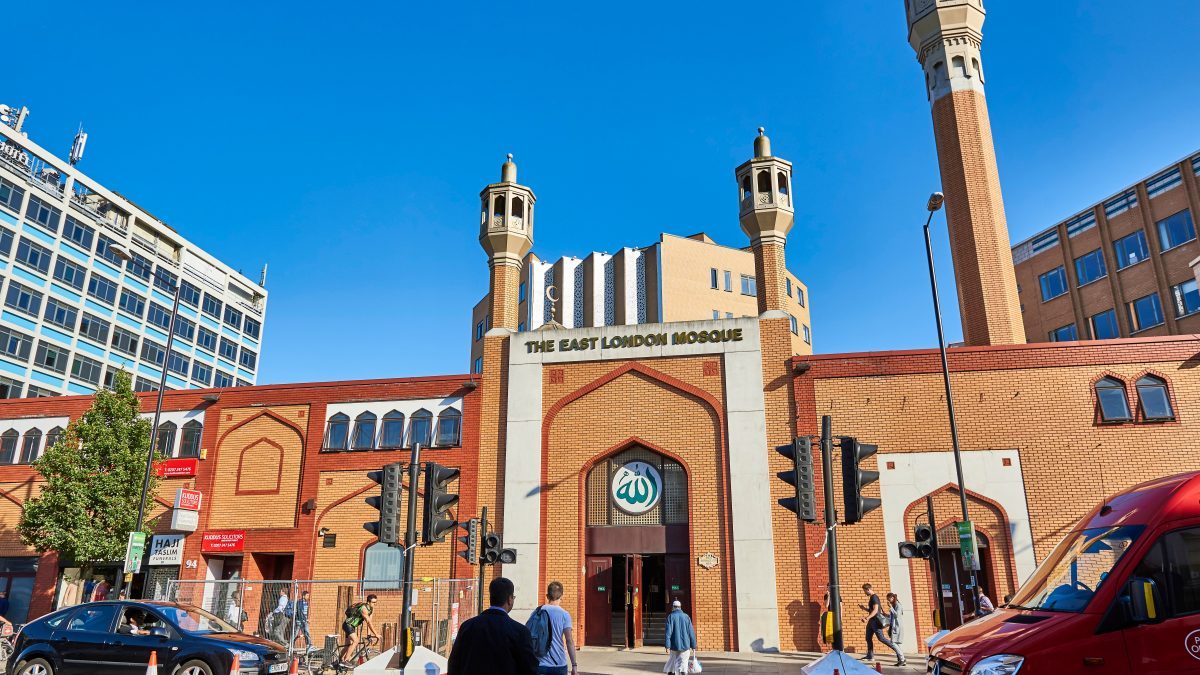
The East London Mosque grew out of a fund set up in 1910 to build a central mosque in the capital, and it became one of the most important mosques in the country. Its current building on Whitechapel Road opened in 1985, and it is now one of the largest mosques in Western Europe.
Migration after the Second World War
The big change came after the Second World War. Britain needed workers to rebuild its factories, mills and transport systems, and the British Nationality Act of 1948 gave people from the Commonwealth the right to live and work in Britain. Men from Pakistan, India and Bangladesh began to arrive in large numbers in the 1950s and 1960s.
Many of the early Pakistani migrants came from Mirpur, a district in what is now Azad Kashmir. In the 1960s, the building of the Mangla Dam flooded villages in Mirpur, and many families moved to Britain. They found work in the textile mills of Yorkshire and Lancashire, the factories of the Midlands, and transport and manufacturing in London. Bangladeshi migrants came mostly from Sylhet, and many found work in restaurants and factories in east London. Indian Muslims came from Gujarat and other regions.
At first, most of these migrants were men who planned to work for a few years and return home. They lived in shared houses and sent money back to their families, but over time many decided to stay. In the 1960s and 1970s, wives and children joined them, and the community became settled. New laws in the 1970s made it harder for new workers to come, so the community grew mainly through family growth.
Another wave came in 1972, when the ruler of Uganda, Idi Amin, expelled the country's Asian population. About 28,000 Ugandan Asians came to Britain, many of them Muslims from Gujarat. They arrived with almost nothing, but many rebuilt their lives in business and trade, especially in Leicester and north-west London.
Building mosques and communities
As the community grew, it built the institutions of a settled life. Mosques appeared in every city with a Muslim population. Birmingham Central Mosque opened in 1975, and Bradford, Manchester, Leicester, Glasgow and many smaller towns built their own. Today there are more than 1,800 mosques in Britain.
Muslim families also built halal food shops, Islamic schools and community centres. The first Muslim schools opened in the 1980s and 1990s, and today there are more than 180 in Britain, most of them independent. Muslim charities grew as well, raising money for disaster relief and for projects at home.
The community also became more diverse. Alongside the large Pakistani, Bangladeshi and Indian communities, there are Arab, Turkish, Somali, Nigerian and many other Muslim communities, plus a growing number of British converts. London alone is home to Muslims from almost every country in the world.
Muslims in Britain today
The 2021 census showed that Muslims are a young and growing part of Britain, with about half under 30. Most live in England, especially in London, Birmingham, Bradford, Manchester and Leicester. In some areas, such as Tower Hamlets in east London, Muslims make up a large share of the local population.
British Muslims have entered every part of public life. Mohammad Sarwar became the first Muslim member of parliament in 1997, elected in Glasgow. Sadiq Khan became the Mayor of London in 2016, the first Muslim mayor of a major Western capital. Humza Yousaf became the First Minister of Scotland in 2023, the first Muslim to lead a government in the United Kingdom.
In sport and culture, British Muslims are well known. The runner Mo Farah, born in Somalia and raised in London, won four Olympic gold medals, and the boxer Amir Khan, from Bolton, became a world champion.
The community has also faced real challenges. After the attacks of 11 September 2001 and the London bombings of 7 July 2005, many British Muslims reported rising hostility. Surveys have found that Muslims in Britain face higher levels of discrimination in work and housing than other groups. Mosques have responded with open days, food banks and youth projects that serve people of all faiths, and by building links with neighbours.
Why this history matters
The history of Muslims in the UK is part of the longer story of Islam in Europe. It shows that Islam is not new to Britain. Muslim sailors walked the docks of Cardiff more than 150 years ago, and the first mosque in the country was built in 1889. The modern community grew out of the post-war rebuilding of Britain, when Muslim workers helped run its mills, factories and hospitals.
For the millions of Muslims in Britain today, this history is a reminder that they belong to a community with deep roots in the country. For everyone else, it is a reminder that Britain's story has always been shaped by people who came from far away and made it home.
Frequently asked questions
When did Islam first come to Britain?
Muslims first arrived in Britain in the 1600s, as traders and diplomats. A settled community began in the 1800s, when Yemeni and Somali sailors settled in Cardiff and South Shields. The first purpose-built mosque, the Shah Jahan Mosque in Woking, was built in 1889.
How many Muslims live in the UK?
About 3.9 million people in England and Wales described themselves as Muslim in the 2021 census, around 6.5 percent of the population. The total for the whole United Kingdom is close to 4 million.
What was the first mosque in Britain?
The Shah Jahan Mosque in Woking, Surrey, built in 1889, was the first purpose-built mosque in Britain. In the same year, Abdullah Quilliam opened the Liverpool Muslim Institute, which also served as a mosque.
Where do most British Muslims live?
Most British Muslims live in England, especially in London, Birmingham, Bradford, Manchester and Leicester. London has the largest Muslim population of any city in the country.
When did large-scale Muslim migration to Britain begin?
Large-scale migration began after the Second World War, in the 1950s and 1960s, when workers from Pakistan, India and Bangladesh came to work in Britain's mills, factories and transport systems. Families joined them in the 1960s and 1970s, and the community became settled.