Muslim Sicily was the island of Sicily under Muslim rule from 827 to 1091, when Arab and Berber rulers from North Africa governed the island and turned its capital, Palermo, into one of the richest cities in Europe. The period lasted a little over 260 years, and it changed Sicily in lasting ways, from the crops in its fields to the words in its language and the domes on its churches.
How the conquest began
In the early 800s, Sicily belonged to the Byzantine Empire, the Christian empire based in Constantinople. The island was rich and well placed in the middle of the Mediterranean, but its rulers were weak and divided. In 827, a Muslim army crossed from Ifriqiya, the region we now call Tunisia, and landed at Mazara on the western coast. The commander was Asad ibn al-Furat, a judge and scholar who led the expedition for the Aghlabid rulers of Ifriqiya.
The conquest was slow. Palermo, the main city, fell in 831 after a long siege, and it became the capital of the new Muslim province. Syracuse, the great Byzantine port in the east, held out until 878. The last Byzantine stronghold, Taormina, fell in 902. By then, Sicily was firmly part of the Muslim world, and its rulers answered to the Aghlabids in North Africa, and later to the Fatimid caliphs in Cairo.
A golden age in Palermo
Under Muslim rule, Palermo grew into a city that travellers described with wonder. The geographer Ibn Hawqal, who visited in the 900s, wrote that Palermo had hundreds of mosques and busy markets, and that its people lived well. The city had running water, gardens and suburbs that stretched far beyond the old walls. At its height, Palermo was one of the largest cities in Europe, and some writers said its population reached several hundred thousand, though modern historians think the real number was smaller.
The rulers of the island were first the Aghlabids, then the Fatimids, and finally a local dynasty called the Kalbids, who ruled from about 948 to 1053. Under the Kalbids, Sicily was largely independent, and Palermo became a centre of poetry, learning and trade. Ships from Palermo carried grain, silk and sugar across the Mediterranean, and the island traded with North Africa, Spain and Italy.
What the Muslims brought to Sicily
The Muslim period changed how Sicily farmed its land. Arab farmers brought new crops and new ways of watering them. They introduced citrus fruits, including lemons and bitter oranges, sugar cane, cotton, rice, dates and aubergines. They built qanats, underground channels that carried water to dry fields, and they improved irrigation across the island. Many of these crops are still part of Sicilian cooking today, and the island's famous sweet pastries, made with sugar and almonds, trace back to this period.
The Arabic language also left its mark. Hundreds of Sicilian place names come from Arabic. Marsala comes from Marsa Allah, meaning the harbour of God. Alcamo, Calatafimi and many other town names keep Arabic roots. Words in the Sicilian dialect, like the word for a water channel and several farming terms, also come from Arabic. The island's fishing boats, markets and cooking all carry traces of the period.
Sicilian art and building changed too. Muslim builders used domes, pointed arches and bright geometric decoration, and these styles mixed with Byzantine and Latin traditions. The result was a style later called Arab-Norman, which you can still see in Palermo's churches and palaces.
The Norman conquest
By the middle of the 1000s, the Kalbid rulers had split into rival city states, and the island was divided. This gave an opening to the Normans, Christian knights from northern France who had already taken southern Italy. In 1061, Roger de Hauteville, known as Roger I, landed in Sicily. He took Messina, then Palermo in 1072, and by 1091 the whole island was under Norman rule.
The change of rulers did not wipe out Muslim Sicily in one stroke. The Normans needed the island's farmers, traders and officials, so they kept much of the old system. Arabic stayed a language of government for decades. Muslim officials served in the Norman court, Muslim soldiers fought in Norman armies, and Muslim craftsmen built Norman churches. The most famous example is the court of Roger II, who ruled from 1130 to 1154. His geographer, Muhammad al-Idrisi, a Muslim scholar from Ceuta, made a great world map for him in 1154, the Tabula Rogeriana, one of the best maps of the medieval world.
The Arab-Norman churches
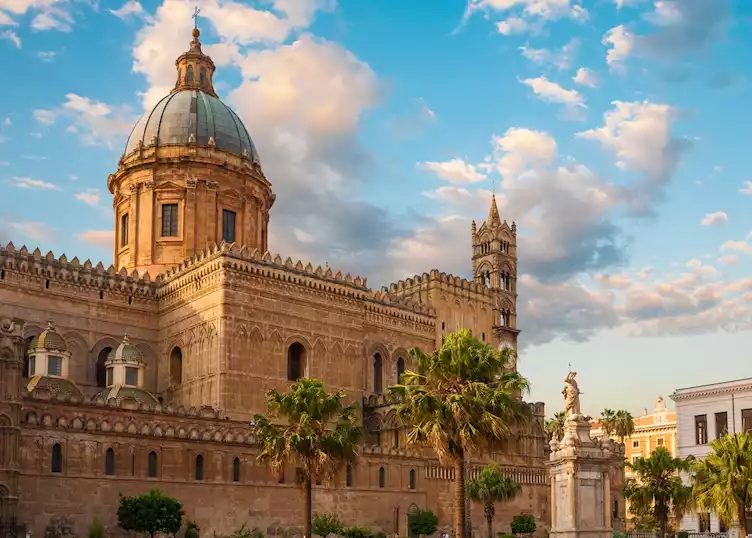
The Norman kings built churches that mixed Norman, Byzantine and Arab styles, and they are the clearest sign of Muslim Sicily that visitors see today. Palermo Cathedral, built from 1184 on the site of the city's great mosque, has arched windows and a tower that show the old Arab style. The church of San Giovanni degli Eremiti, with its red domes, looks like a mosque at first glance. The great church of Monreale, just outside Palermo, has golden mosaics made by Byzantine artists and arches shaped by Arab builders. Cefalu Cathedral, on the north coast, mixes the same traditions. UNESCO has listed these Arab-Norman buildings as a World Heritage Site, and they draw visitors from all over the world.
The slow end of Muslim Sicily
Muslim life in Sicily faded slowly after the Norman conquest. Under Roger I and Roger II, Muslims lived and worked openly, but later kings put more pressure on them. The emperor Frederick II, who ruled Sicily in the 1200s, deported many Sicilian Muslims to the town of Lucera on the Italian mainland, where they formed a Muslim colony that lasted until 1300. Others left for North Africa or converted to Christianity. By the end of the 1200s, open Muslim life in Sicily had mostly ended.
Even so, the Muslim period never really left the island. It is in the food, the farming, the place names and the buildings. When visitors walk through Palermo and see palm trees beside a Norman church with Arab arches, they are looking at the island's Muslim past, still standing in stone.
Why Muslim Sicily matters for Europe
Muslim Sicily is one of the clearest examples of how Islam shaped Europe long before the modern age. The island was a meeting point where Arab, Greek and Latin cultures worked side by side, and the result was new farming, new science, new maps and new art. For Muslims living in Europe today, in Britain, France, Germany, Spain and the Netherlands, Sicily is a reminder that Muslim history in Europe is not new. It goes back more than a thousand years, and it is written into the streets and churches of one of Europe's most visited islands.
Frequently asked questions
When did Muslims rule Sicily?
Muslim rule in Sicily ran from 827, when the first army landed at Mazara, to 1091, when the Normans completed their conquest of the island. That is about 264 years. The conquest itself took decades, and Palermo became the Muslim capital in 831.
Who conquered Sicily for Islam?
The conquest was launched by the Aghlabids, the Muslim rulers of Ifriqiya in modern Tunisia. The first commander was Asad ibn al-Furat, a judge and scholar. Later the island passed to the Fatimids of Cairo, and then to the local Kalbid dynasty, who ruled it as a mostly independent emirate.
What did Muslims introduce to Sicily?
They brought new crops such as citrus fruits, sugar cane, cotton and rice, and new irrigation methods including underground water channels. They also brought Arabic words that survive in Sicilian place names, new building styles with domes and pointed arches, and a trading network that linked the island to North Africa and Spain.
Why does Palermo Cathedral look Arab?
Palermo Cathedral was built from 1184 on the site of the city's great mosque, and its builders kept the Arab style of arches, domes and decoration that was common in the city. Under the Norman kings, Christian churches were often built by Muslim craftsmen, so Arab and Norman styles mixed in the same buildings.
Are there still Muslims in Sicily today?
Yes. Sicily has a Muslim community today, made up of migrants from North Africa and other countries as well as Italian converts. The community is much newer than the medieval one, but it keeps a living link between the island and the Muslim world.