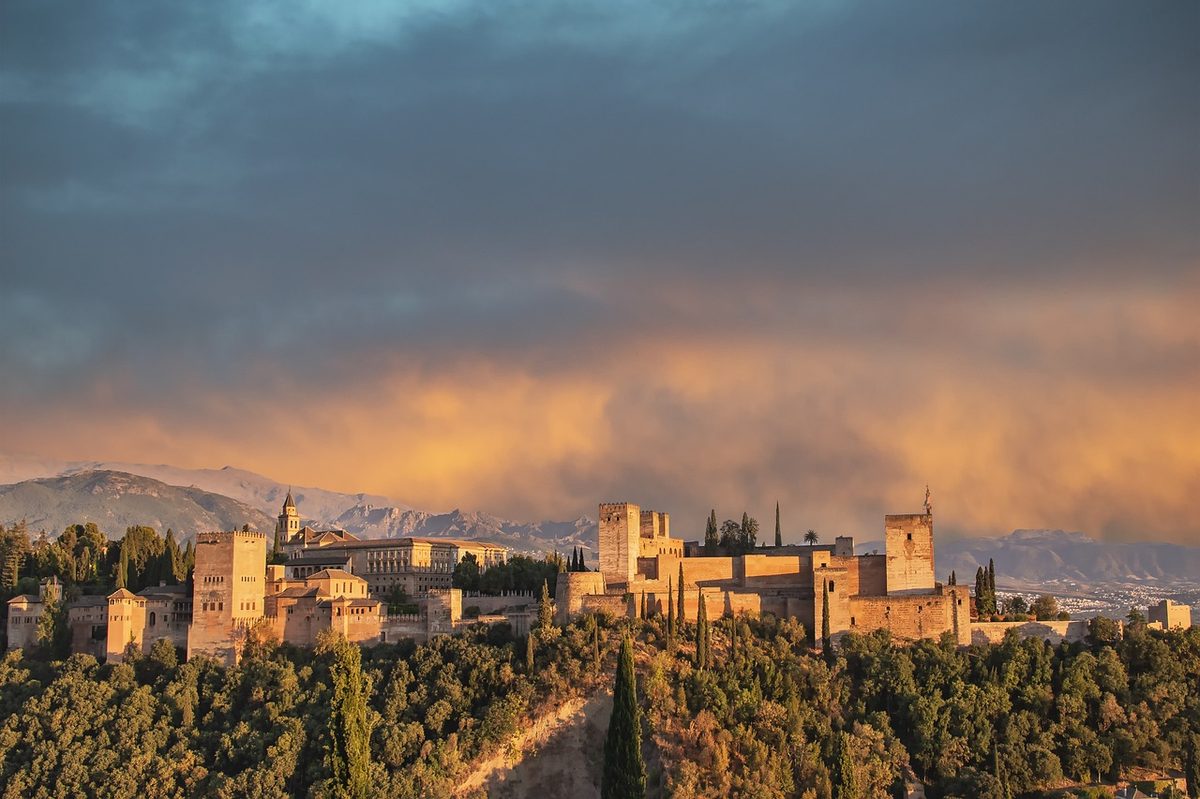
The Alhambra is a palace and fortress built by Muslim rulers in Granada, in southern Spain, and it is one of the most famous buildings from the history of Islam in Europe. For more than 250 years it was the home of the Nasrid kings, the last Muslim dynasty in Spain. Today it is a UNESCO World Heritage Site and one of the most visited places in the country. Its red walls, carved courtyards and quiet gardens still tell the story of Al-Andalus, the Muslim Spain that lasted for almost 800 years.
What is the Alhambra?
The Alhambra stands on the Sabika hill, above the city of Granada, with the snow covered Sierra Nevada mountains behind it. It is not a single palace but a whole complex: a fortress, royal palaces, houses, baths, mosques and gardens, all inside strong walls. The word Alhambra comes from the Arabic al-hamra, meaning the red one, because the walls and towers have a reddish colour in the sunlight.
The site was used as a fortress long before the Nasrids. Roman and Visigothic walls stood there, and Muslim rulers used the hill from the 800s onward. But the Alhambra we see today was mostly built in the 1300s, when Granada was the capital of the last Muslim kingdom in Spain.
The Nasrid kings who built it
In 1238, Muhammad I, also known as Ibn al-Ahmar, founded the Nasrid dynasty and made Granada his capital. He began turning the old fortress on the Sabika hill into a royal palace. His successors kept adding to it for more than a century.
The greatest building work happened under Yusuf I, who ruled from 1333 to 1354, and his son Muhammad V, who ruled from 1354 to 1391. They built the Nasrid Palaces, the most beautiful part of the complex, with carved plaster walls, tiled floors, wooden ceilings and courtyards open to the sky. The famous Court of the Lions, with its fountain held up by twelve stone lions, was built under Muhammad V.
The rulers did not build only for show. The Alhambra was a working royal city. It had its own water supply, brought from the mountains by channels, and it held the court, the government offices, the royal guard, workshops and the homes of officials. At its height, about 2,000 people lived inside its walls.
Inside the palaces
The Nasrid Palaces are made of three main parts. The Mexuar was the hall where the king met visitors and held court. The Comares Palace held the throne room, the Hall of the Ambassadors, where the king received foreign envoys under a wooden ceiling that was made to look like the stars of the sky. The Palace of the Lions was the private home of the royal family, built around courtyards and gardens.
Two halls in the Palace of the Lions are especially famous. The Hall of the Two Sisters has a domed ceiling covered in carved plaster that looks like a honeycomb. The Hall of the Abencerrajes takes its name from a noble family of Granada, and a sad legend says members of that family were killed there.
Beside the palaces stands the Generalife, the summer palace of the kings, with gardens, fountains and long pools of water. The word comes from the Arabic Jannat al-Arif, meaning the garden of the architect, or the highest garden. It was a place for rest, away from the formal court.
The Alcazaba and the Christian palace
The oldest part of the complex is the Alcazaba, the fortress at the western end of the hill. Its towers and thick walls guarded the city, and its watchtower, the Torre de la Vela, still stands over Granada. From its top, visitors can see the whole city and the mountains beyond it.
After 1492, when the Catholic monarchs Ferdinand and Isabella took Granada, they added their own building to the Alhambra. The Palace of Charles V, begun in 1526, is a large Renaissance building with a round courtyard inside a square shape. It looks very different from the Nasrid palaces, and it stands as a clear sign of the change of rule. The old royal mosque was also turned into a church.
The fall of Granada in 1492
The year 1492 ended Muslim rule in Spain. Granada had been the last Muslim kingdom on the peninsula, and it had survived for over two centuries after the other Muslim states had fallen. In January 1492, the last Nasrid king, Muhammad XII, known in Spanish history as Boabdil, handed the keys of the city to Ferdinand and Isabella.
A well known story says that as Boabdil left Granada and looked back at the city for the last time, his mother told him not to weep like a woman for what he could not defend like a man. Historians are not sure the words were really spoken, but the place where he is said to have looked back is still called the Sigh of the Moor.
After the surrender, the Muslim population of Granada stayed at first, but within a few years they faced pressure to convert to Christianity, and many were later expelled from Spain. The Alhambra itself passed to the Spanish crown.
Centuries of neglect and rediscovery
For the next 300 years, the Alhambra was used as a military base, and parts of it fell into ruin. Roofs leaked, walls cracked, and some buildings were damaged by an explosion in 1812, when French troops left the site during the Peninsular War.
The palace became famous again in the 1800s, when travellers and writers from Europe and America began to visit Granada. The American writer Washington Irving lived in the Alhambra in 1829 and wrote Tales of the Alhambra, a book of stories and legends about the palace that made it famous around the world. Restoration work began, and in 1870 the Alhambra was declared a national monument of Spain.
In 1984, UNESCO added the Alhambra and the Generalife to its World Heritage List, recognising them as an outstanding example of Muslim art and architecture in Europe.
Why the Alhambra still matters
The Alhambra matters for three reasons. First, it is one of the finest examples of Islamic art in Europe, with calligraphy, geometric patterns and carved plaster that show the skill of the craftsmen of Al-Andalus. Second, it is a record of a time when Muslims, Christians and Jews lived in Spain together, and when Granada was a centre of learning, trade and art. Third, it is a living place: millions of people visit it each year, and it is one of the strongest links between modern Spain and its Muslim past.
For Muslim visitors from Europe, it holds a special meaning. It stands in a modern European city, built by Muslims, open to all, and still cared for after more than 700 years. It is proof that Islamic history is not only a story of the Middle East or South Asia. A large part of it happened in Europe too.
Visiting the Alhambra today
The Alhambra is open to visitors all year round, but tickets for the Nasrid Palaces sell out quickly, so visitors usually need to book in advance. A normal visit takes about three hours, and it covers the Alcazaba, the Nasrid Palaces, the Generalife and the Palace of Charles V. The best time to visit is early in the morning or late in the afternoon, when the light turns the red walls gold.
Frequently asked questions
Who built the Alhambra?
The Alhambra was built mainly by the Nasrid kings of Granada, starting with Muhammad I in 1238. The most famous parts, including the Court of the Lions, were built under Yusuf I and Muhammad V in the 1300s.
What does Alhambra mean?
Alhambra comes from the Arabic al-hamra, meaning the red one. It refers to the reddish colour of the walls and towers of the fortress.
When did Muslims lose the Alhambra?
The last Muslim king of Granada, Muhammad XII, known as Boabdil, surrendered the city and the Alhambra to Ferdinand and Isabella in January 1492. That ended Muslim rule in Spain.
How old is the Alhambra?
The main palaces were built in the 1300s, so they are about 700 years old. The fortress on the same hill is older, with walls that go back to Roman and early Muslim times.
Is the Alhambra a UNESCO site?
Yes. UNESCO added the Alhambra and the Generalife to the World Heritage List in 1984, because of their outstanding value as examples of Muslim art and architecture.