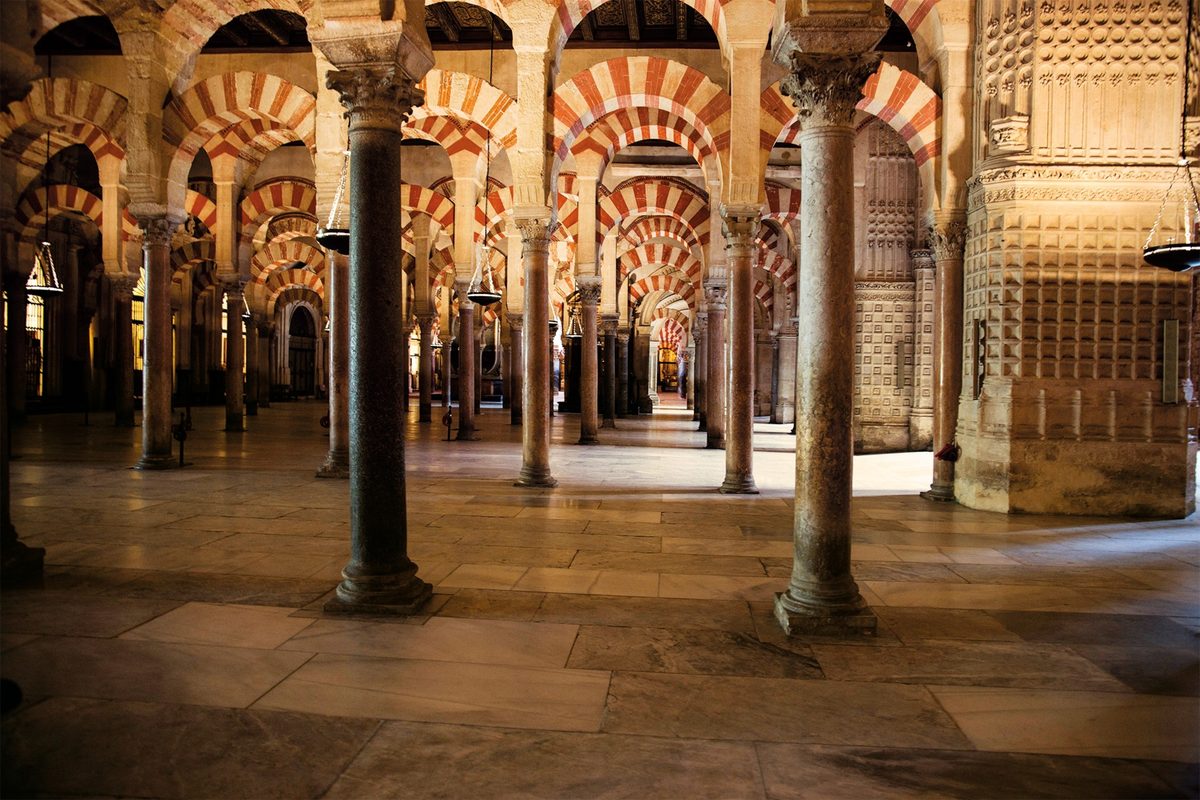
The Great Mosque of Cordoba is one of the most famous buildings of the Muslim world, and it stands in the south of Spain, in the city of Cordoba. Work on it began in 785, under Abd al-Rahman I, the founder of the Umayyad state in Spain. Over the next two hundred years, his successors kept adding to it until it became one of the largest mosques in the world. Today it is a cathedral, but its prayer hall still looks like a mosque, and it draws millions of visitors every year.
How the mosque began
When Abd al-Rahman I arrived in Spain in 756, he was a refugee prince. His family, the Umayyads, had ruled the Muslim world from Damascus, but they had been overthrown by the Abbasids. Abd al-Rahman escaped across North Africa and reached Spain, where he built a new state with Cordoba as its capital.
About thirty years later, in 785, he began building a great mosque in the centre of the city. The story most often told is that the site held a church, the Church of St Vincent, which was shared between Christians and Muslims, and that Abd al-Rahman bought the Christian half of the building so he could build his mosque there. Historians debate the details, but the date of the first building is well established.
The first mosque was not huge. It had a prayer hall with eleven rows of arches running toward the south wall, and a courtyard with a minaret. What made it special was the design of those arches. The builders used two levels of arches, one above the other, with red brick and white stone in alternating bands. The shape gave the hall height and light, and it became the most famous feature of the building.
Growth under later rulers
Abd al-Rahman I died in 788, but his successors kept enlarging the mosque. His son Hisham I added a minaret. Abd al-Rahman II, who ruled from 822 to 852, extended the prayer hall to the south. Al-Hakam II, who ruled from 961 to 976, added one of the most beautiful parts of the mosque: a richly decorated mihrab, the niche that shows the direction of prayer, surrounded by gold mosaics and carved marble. He also added a domed ceiling over the area in front of the mihrab, with arches that cross each other in a complex pattern.
The last great expansion came under al-Mansur, the powerful minister who ruled in the name of the caliph from 978 to 1002. He extended the hall to the east, adding eight more rows of arches. By then, the mosque was about 180 metres long and 130 metres wide, with around 850 columns. It could hold tens of thousands of worshippers. It was the largest mosque in the West, and one of the largest in the whole Muslim world.
The mosque was more than a place of prayer. It was the centre of the city. Scholars met there, copies of the Quran were made there, and the caliph led Friday prayers in a special enclosed area called the maqsura, close to the mihrab. The courtyard, known as the Patio de los Naranjos, or Courtyard of the Orange Trees, was a place for washing before prayer and for meeting friends. Orange trees still grow there today.
The fall of Muslim Cordoba
Cordoba was the capital of Muslim Spain for more than two centuries, but its power faded after the caliphate broke apart in the early 1000s. The city fell to the Christian king Ferdinand III of Castile in 1236, during the long period of Christian advance known as the Reconquista. The mosque was consecrated as a cathedral, the Cathedral of Our Lady of the Assumption, and a Christian altar was placed in the prayer hall.
For nearly three hundred years, the building changed very little. The Christian kings used it as a cathedral but kept the mosque almost as it was. Then, in the 1500s, a decision was made that still causes debate today. In 1523, the Emperor Charles V gave permission to build a large Renaissance cathedral nave, with a high vaulted ceiling, right in the middle of the old prayer hall. Part of the mosque had to be pulled down to make room for it.
The story goes that when Charles V saw the result, he said, "You have destroyed what was unique in the world, and built what is commonplace." Whether he said those exact words or not, the story captures the feeling of many visitors. The tall Christian nave rises out of the flat forest of arches, and the contrast is strange and striking.
The mosque today
Today, the building is officially the Mosque-Cathedral of Cordoba. It is a working Catholic cathedral, and it is also a UNESCO World Heritage Site, listed in 1984. Visitors enter through the Patio de los Naranjos, past the old minaret, which was rebuilt in the 1600s as a bell tower. Inside, they walk through the forest of columns and red and white arches, past the mihrab of al-Hakam II, and into the Renaissance nave in the centre.
The building is a symbol of Spain's Muslim past, and also of the long and complicated history that followed. For Muslims in Europe, it is a reminder that Islam was part of Europe for almost eight hundred years. In Cordoba, the call to prayer has not sounded for centuries, but the building still speaks for the age when the city was one of the great centres of learning and art in the world.
People who visit Cordoba often say the mosque is the most impressive building in Spain. It is not the tallest or the grandest. It is impressive because of its size, its age, and its design. Standing in the prayer hall, under the double arches, you can still feel what the builders of the 700s wanted you to feel: a forest of stone that seems to go on forever.
Frequently asked questions
When was the Great Mosque of Cordoba built?
Work began in 785 under Abd al-Rahman I, the founder of the Umayyad state in Spain. Later rulers expanded it over the next two hundred years, and the final large expansion was made by al-Mansur around 990.
Is the Great Mosque of Cordoba still a mosque?
No. After Ferdinand III of Castile took Cordoba in 1236, the mosque was turned into a Catholic cathedral. Today it is officially the Mosque-Cathedral of Cordoba, and it works as a cathedral, though its prayer hall still looks like a mosque.
Why are the arches red and white?
The builders used alternating bands of red brick and white stone. The double arches, one level above the other, gave the hall extra height and let in more light. The pattern became the most famous feature of the building and was copied in other mosques in Spain and North Africa.
What is the mihrab of the Great Mosque?
The mihrab is the niche in the south wall that shows the direction of prayer toward Mecca. The one in Cordoba was built under al-Hakam II in the 900s. It is decorated with gold mosaics, carved marble and Arabic writing, and it is one of the finest examples of Islamic art in Europe.
Can visitors go inside the Mosque-Cathedral of Cordoba?
Yes. It is open to visitors every day, with tickets sold at the door and online. The best time to visit is early in the morning, before the crowds arrive, when the prayer hall is quiet and the light comes through the arches.