Islam came to the Balkans mainly with the Ottoman Turks, who moved into south-east Europe from the late 1300s onward and ruled most of the region for hundreds of years. Over the centuries that followed, many local people converted to Islam, and Muslim towns, mosques and neighbourhoods grew across the peninsula. Today, millions of Muslims live in the Balkans, in countries such as Bosnia and Herzegovina, Albania, Kosovo and North Macedonia, and their history is one of the oldest chapters of Islam in Europe.
First contacts before the Ottomans
Islam first touched the Balkans long before the Ottomans arrived, but it did not put down lasting roots. Arab armies raided the edges of the Byzantine Empire in the 700s and 800s, and Muslim traders travelled through the region on their way between the Mediterranean and central Europe. Small groups of Muslim settlers and soldiers are recorded in medieval Hungary and on the Byzantine borderlands, but these were scattered communities, not a settled population.
The change began in the 1300s, when the Ottoman state, based in north-west Anatolia, started to expand across the sea into Europe. The Ottomans were a Muslim Turkish dynasty, and as their armies advanced, their religion, laws and way of running towns came with them.
The Ottoman advance into Europe
The Ottoman crossing into Europe began in the 1350s, when their forces took Gallipoli, on the European side of the Dardanelles. From there they moved quickly, winning the Battle of Maritsa in 1371 and the Battle of Kosovo in 1389, two battles that broke the power of the Serbian and Bulgarian states. By the early 1400s, the Ottomans controlled much of the southern Balkans, and in 1453 they took Constantinople, the Byzantine capital.
Over the next hundred years, Ottoman rule spread further north and west. Belgrade fell in 1521, and by the mid-1500s the Ottomans held most of the Balkans, from the Black Sea to the Adriatic coast. They ruled through governors and soldiers, and built the towns that still shape the Balkans today.
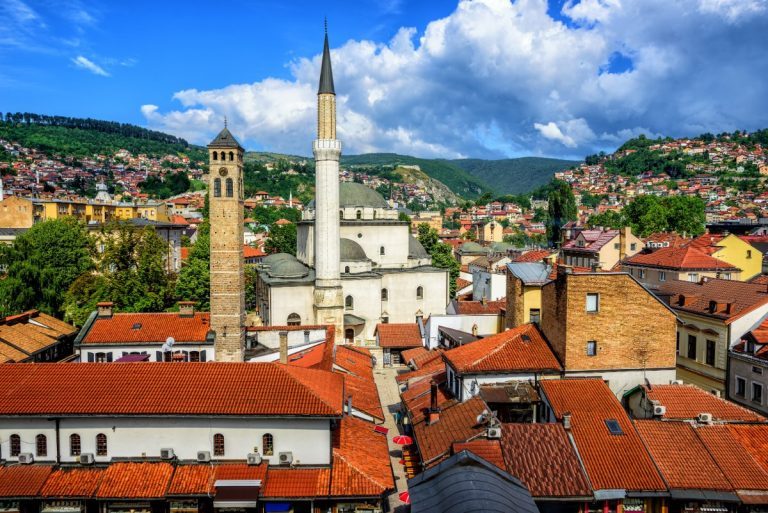
Sarajevo is a good example. Founded in the 1400s by the Ottoman governor Isa-beg Ishakovic, it grew around its mosques, markets and baths. The Gazi Husrev-beg Mosque, built in 1531, still stands in the centre of the old town, beside the Bascharsija market, still busy with traders today.
Why did local people convert?
When the Ottomans arrived, most people in the Balkans were Orthodox or Catholic Christians. Conversion was not forced, and it happened slowly, over several centuries. Historians point to several reasons.
First, there were practical reasons. Muslims paid lower taxes than non-Muslims, who paid a special tax called the jizya. Muslims could also hold government posts and serve as army officers, which gave families a better chance to rise in society. For a farming family or a trader, conversion could mean a real improvement in daily life.
Second, Sufi teachers and preachers played a large part. Sufi lodges, called tekkes, were built in towns and villages across the Balkans, and their teachers lived simply, helped the poor and welcomed visitors of any background.
Third, daily life mixed people together. Towns were shared spaces, with mosques, churches and markets side by side. People married across religious lines, worked together and traded together, and over generations whole families and villages became Muslim.
Conversion happened at different speeds in different places. In Bosnia, many people converted in the 1400s and 1500s, soon after the Ottomans arrived. Some historians link this to the Bogomils, a local Christian group that had been in conflict with the Catholic Church, though the idea is debated. In Albania, large-scale conversion came later, mostly in the 1600s and 1700s. In parts of Bulgaria, the Pomaks, Bulgarian-speaking Muslims, kept their language while adopting Islam. In Kosovo and Macedonia, Albanian and Turkish communities grew around Ottoman towns and garrisons.
Muslim life under Ottoman rule
Under the Ottomans, the Balkans were a mixed society. Muslims were the ruling group, but Christians and Jews kept their own churches, schools and community leaders. Under the millet system, each religious community managed its own family law, schools and charities, while the Ottoman state handled taxes, the army and the courts.
Muslim towns followed the same pattern: a mosque at the centre, often with a minaret, a courtyard and a fountain for washing before prayer, with markets, baths, schools and Sufi lodges around it. Bridges, caravanserais and clock towers followed the same Ottoman style. The Old Bridge in Mostar, built in 1566, is one of the most famous examples, and it still stands today after being rebuilt in 2004.
Muslim culture also shaped the language, the food and the music of the region. Words of Turkish and Arabic origin entered the local languages, and dishes such as burek and baklava, and Turkish coffee, became part of everyday life across the whole peninsula, not only among Muslims.
The end of Ottoman rule
Ottoman power in the Balkans weakened in the 1800s. Greece became independent in the 1830s, and Serbia, Romania and Bulgaria followed in the 1870s. Austria-Hungary took control of Bosnia in 1878 and annexed it in 1908. The Balkan Wars of 1912 and 1913 pushed the Ottomans out of almost all of Europe, and the First World War finished the process.
When the Ottoman Empire fell, millions of Muslims left the Balkans. Some moved to Turkey, some were forced out, and some stayed, keeping their mosques, their communities and their identity as new states were built around them.
The 1900s were hard for Balkan Muslims. In the Second World War and again in the wars of the 1990s, Muslim communities in Bosnia and Kosovo were targeted, and many mosques were destroyed. The siege of Sarajevo from 1992 to 1996 and the war in Kosovo in 1999 are still living memories there, yet the communities survived, and many of their mosques and old towns were rebuilt after the wars.
Muslims in the Balkans today
Today, Muslims are a large part of the population in several Balkan countries. In Bosnia and Herzegovina, about half the population is Muslim, mostly Bosniaks. In Albania, Muslims are the majority, and in Kosovo they are the large majority. In North Macedonia, about a third of the population is Muslim, mostly ethnic Albanians and Turks. Smaller Muslim communities live in Montenegro, Serbia, Bulgaria and Greece, in the region of Western Thrace.
Many of these Muslims are European in every sense: they speak the local languages, hold local passports and take part in public life. At the same time, they keep a distinct Muslim identity, with mosques, religious schools, festivals and family traditions from the Ottoman centuries.
For Muslims in western Europe, especially in the UK and Germany, the Balkans matter personally too. Many families in Britain, Germany, Austria and Switzerland have roots in Bosnia, Albania or Kosovo, and they visit the region, send money home and keep ties with relatives there.
Why this history matters
The Balkans show that Islam has been part of Europe for more than six hundred years, not a recent arrival. The mosques of Sarajevo, the old towns of Mostar and Prizren, and the Muslim communities of Albania and Kosovo are all part of the European story, shaped by trade, conquest and centuries of shared life.
For a history atlas, the Balkans are a reminder that Muslim history is not only the history of the Middle East. It is also the history of Europe, written in stone, in language and in daily life.
Frequently asked questions
When did Islam first arrive in the Balkans?
Islam first touched the Balkans through Arab raids and Muslim traders in the 700s and 800s, but it became a settled presence only with the Ottoman expansion from the late 1300s onward.
Which Balkan countries have large Muslim populations today?
Bosnia and Herzegovina, Albania and Kosovo have Muslim majorities or near majorities. North Macedonia has a large Muslim minority of about a third of the population, and smaller communities live in Montenegro, Serbia, Bulgaria and Greece.
Were people in the Balkans forced to convert to Islam?
No. Conversion happened slowly, over centuries, and historians point to tax differences, better chances of government work, the work of Sufi teachers and everyday mixing in shared towns as the main reasons.
What is the Gazi Husrev-beg Mosque in Sarajevo?
It is the main mosque of Sarajevo, built in 1531 under the Ottoman governor Gazi Husrev-beg. It stands in the centre of the old town, next to the Bascharsija market, and is one of the most important Ottoman buildings in the Balkans.
When did Ottoman rule in the Balkans end?
Ottoman rule weakened through the 1800s and ended with the Balkan Wars of 1912 and 1913 and the First World War. By the end of the war, the Ottomans held almost no land in Europe.