Iran has said the Strait of Hormuz could reopen within two days if the United States meets its conditions for a deal. The offer came on the same weekend that a third US aircraft carrier arrived in the Middle East, and Iran said it still regards itself as being in a state of war. Here is what happened, what each side is saying, and why the strait matters to the whole world.
What Iran proposed
Iran's Deputy Foreign Minister, Kazem Gharibabadi, gave a televised interview to the Iranian state news agency IRNA on Sunday 15 November. He said Iran had proposed a plan that could end the war and reopen the Strait of Hormuz within two days. The plan was already on the table, he said, and the measures in it could be carried out in 48 hours.
Gharibabadi said the original proposal had set out seven days to end the war and reopen the waterway. After two months of talks with mediators, he said, the timeline had been reduced to two days. "This means the measures could be carried out within two days and ultimately lead to the reopening of the Strait of Hormuz," he said.
He also said Iran was ready for three possible outcomes: diplomacy, a continued economic blockade, or military confrontation. And he rejected the idea that the two countries were in a state of "neither war nor peace". "My personal belief is that from a legal perspective, we are still in a state of war," he said.
What is stopping a deal
Gharibabadi set out Iran's demands. He said a deal would need a permanent end to the war on all fronts, the removal of the US blockade on Iranian ports, a solution for Iran's blocked assets, and the lifting of some sanctions, including restrictions on the oil sector. He also said the United States would need to take practical steps about the extra military equipment and forces it had deployed in the region after the two sides reached an earlier understanding.
The problem, he said, is timing. The United States wants to delay some of these steps, while Iran says all of them must happen at the same time. "These proposals are not operational from our perspective, because if even one of those issues I mentioned is not implemented at the current stage, fundamentally no understanding can be reached," he said.
Gharibabadi also accused the United States of breaking its promises in the past. He said Washington had shown bad faith at least three times in the past year and a half, and he said this had destroyed Iran's trust. He said the US would have to rebuild that trust before talks could succeed.
As of Monday morning, the United States had not publicly accepted the two-day plan. The proposal remains under discussion through mediators, with the timing of each side's steps still unresolved.
A third US aircraft carrier arrives
At the same time, the United States has been building up its naval force in the region. A US official told ABC News that the aircraft carrier USS Theodore Roosevelt entered the US Central Command area of operations early on Sunday. It joins the USS George H.W. Bush and the USS George Washington, which are already deployed in the Arabian Sea. More than 20 US Navy vessels are now involved in enforcing the blockade of Iranian ports, according to reports.
The conflict began with American and Israeli strikes on Iran on 28 February 2026. The United States imposed its blockade on Iranian ports on 13 April 2026, after nuclear talks broke down. The blockade covers commercial ships travelling to and from Iranian ports and coastal areas.
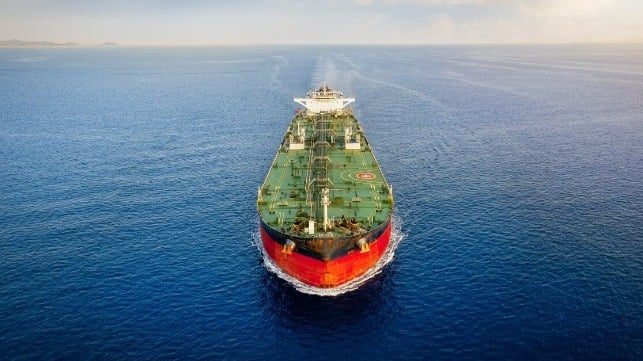
Iran's Revolutionary Guard also said its drones targeted a US air defence radar site at the Riffa helicopter base in Bahrain early on Sunday, its second attack on Bahrain in three days. Bahrain said its air defences intercepted the drones. The Guard also said the Strait of Hormuz was closed, and it claimed two oil tankers had hit naval mines south of the strait, a claim that maritime authorities had not verified. Reports said only five commodity ships crossed the strait on Saturday 14 November and none crossed on Sunday 15 November, according to ship tracking data reported by Reuters.
Why the strait matters to the world
The Strait of Hormuz is a narrow passage of water between Iran and Oman. It connects the Persian Gulf to the open sea. Before the war, about a fifth of the world's oil and liquefied natural gas passed through it every day. It is the only sea route out of the Gulf, which makes it one of the most important shipping lanes in the world.
The closure of the strait has already had effects far beyond the Gulf. A senior UN official, Jorge Moreira da Silva, the head of the UN Office for Project Services, said at the COP31 climate talks in Antalya on Saturday that Iran and the United States should "immediately" allow fertiliser shipments through the strait. Before the conflict, a third of the world's fertilisers passed through Hormuz. Since the blockades began, fertiliser prices have risen by about 30 percent. Moreira da Silva said the shortage could push millions of people into poverty.
The history behind the standoff
The Strait of Hormuz has been fought over before. In the 1980s, during the Iran-Iraq war, both sides attacked oil tankers in the Gulf in what became known as the Tanker War. The United States sent warships to protect shipping, and in 1988 a US warship shot down an Iranian passenger plane, killing all 290 people on board. The strait stayed open, but the episode showed how quickly a local conflict could threaten world trade.
The current war is different in one important way. This time, both sides have imposed blockades: Iran has blocked the strait itself, and the United States has blockaded Iranian ports. Shipping has almost stopped, not just been threatened. That is why the two-day plan matters. If it worked, it would reopen the strait and end the blockades in a matter of days. If it fails, the standoff could drag on, and the costs for ordinary people, from farmers who need fertiliser to families who pay more for fuel, will keep rising.
Frequently asked questions
What is Iran's two-day plan for the Strait of Hormuz?
Iran has proposed a plan that it says could end the war and reopen the Strait of Hormuz within two days. Deputy Foreign Minister Kazem Gharibabadi said the plan was already on the table and that the measures in it could be carried out in 48 hours. The original proposal had set out seven days, but talks with mediators over two months had reduced it to two days.
What does Iran want from the United States?
Iran says a deal needs a permanent end to the war on all fronts, the removal of the US blockade on Iranian ports, a solution for Iran's blocked assets, and the lifting of some sanctions, including on the oil sector. Iran also wants the United States to address the extra military forces it deployed in the region after an earlier understanding.
How many US aircraft carriers are in the Middle East now?
Three. The USS Theodore Roosevelt arrived in the region early on Sunday 15 November, according to a US official quoted by ABC News. It joins the USS George H.W. Bush and the USS George Washington in the Arabian Sea. More than 20 US Navy vessels are involved in enforcing the blockade of Iranian ports.
Why is the Strait of Hormuz so important?
It is the only sea route out of the Persian Gulf. Before the war, about a fifth of the world's oil and liquefied natural gas passed through it every day, along with about a third of the world's fertilisers. Its closure raises oil and fertiliser prices around the world.
Is the Strait of Hormuz open now?
Shipping has almost stopped. Reports said only five commodity ships crossed the strait on Saturday 14 November and none crossed on Sunday 15 November, according to ship tracking data reported by Reuters. Iran's Revolutionary Guard said on Sunday that the strait was closed.