Iran has said it could reopen the Strait of Hormuz within two hours if the United States meets its demands, in the latest shift in a months-long standoff over the world's most important oil waterway. Iranian Foreign Minister Abbas Araghchi made the offer in an interview published on November 20, saying the timetable no longer matters and only Iran's conditions count.
The offer is the shortest yet in a series of shrinking timelines. What began as a seven-day plan became a two-day plan earlier this month, and now, according to Araghchi, it could be done in two hours. The strait itself remains closed to normal traffic, and no deal has been agreed.
What Araghchi actually said
In an interview with Iran Newspaper, Araghchi said the Islamabad memorandum of understanding between Tehran and Washington is "no longer on the table". The memorandum was signed in June 2026, and Araghchi said it had been finalised with the signatures of both countries' presidents. He said Washington violated a key provision of the agreement, which effectively ended it.
Araghchi said Tehran then took the US commitments from the memorandum, added its demands for the lifting of new sanctions, and turned them into a seven-day proposal for reopening the strait. After two months of consultations, he said, the period was shortened to two days, with the United States expected to fulfil its commitments on the first day.
Then came the new offer. "Even if the timetable is reduced from two days to one day or two hours, we have no problem with that," Araghchi said. "What matters is that Iran's demands are met."
He also set out two red lines. First, Araghchi said Iran will not transfer its stockpile of uranium enriched to 60 percent outside the country, though he said Tehran is open to a negotiated solution over the stockpile. Second, he said Iran will not accept an agreement simply to end the current deadlock. Any deal, he said, must safeguard Iran's interests and provide assurances against a renewed war. He pointed out that fighting resumed just 15 days after the June ceasefire, and asked: "What is the point of reaching an agreement today if it is violated two months later and war resumes?"
Araghchi confirmed that Tehran and Washington are still exchanging messages and proposals through Qatar and Pakistan, and he said Iran's Supreme National Security Council would review any proposed agreements before giving final approval.
What the United States said
US President Donald Trump said on Friday that Tehran wants an agreement, but not one Washington considers acceptable. Trump has also repeated his claim that Washington has "total control" over the Strait of Hormuz.
The US State Department told Al Jazeera that Washington's economic pressure campaign against Iran will increase "in the coming days". The US Treasury Department has imposed sanctions on four Iranian nationals accused of helping Tehran collect oil revenues and evade restrictions.
At home, the war is also a political question. Democratic Representatives Yassamin Ansari and Ro Khanna have called on Congress to block funding for offensive military operations against Iran, ahead of a December 11 deadline to approve government spending and avoid a shutdown. They said resources should be directed to domestic priorities instead.
A war that keeps widening
The Hormuz offer came on a day of fighting across the region. The Saudi-led coalition said early on Saturday that it had intercepted three ballistic missiles headed for Riyadh, after explosions were heard in the Saudi capital. Saudi Arabia issued and then lifted emergency alerts for Riyadh for the third night in a row, two days after the capital's Public Investment Fund skyscraper, the tallest building in the country, was hit by Houthi missiles.
The Houthis, who control much of Yemen, have threatened a Saudi power station, Red Sea ports including Jeddah, and Riyadh's financial centre, after the Saudi-led coalition said it hit the Houthi-held port of Hodeidah and the capital Sanaa.
Iran's Islamic Revolutionary Guard Corps said its Aerospace Force shot down another US MQ-9 drone over the Strait of Hormuz, using what it described as a new air defence system. Iranian state broadcaster IRIB reported that the incident marked the 58th US MQ-9 drone brought down by Iranian forces, a claim that has not been independently verified.
Why the Strait of Hormuz matters
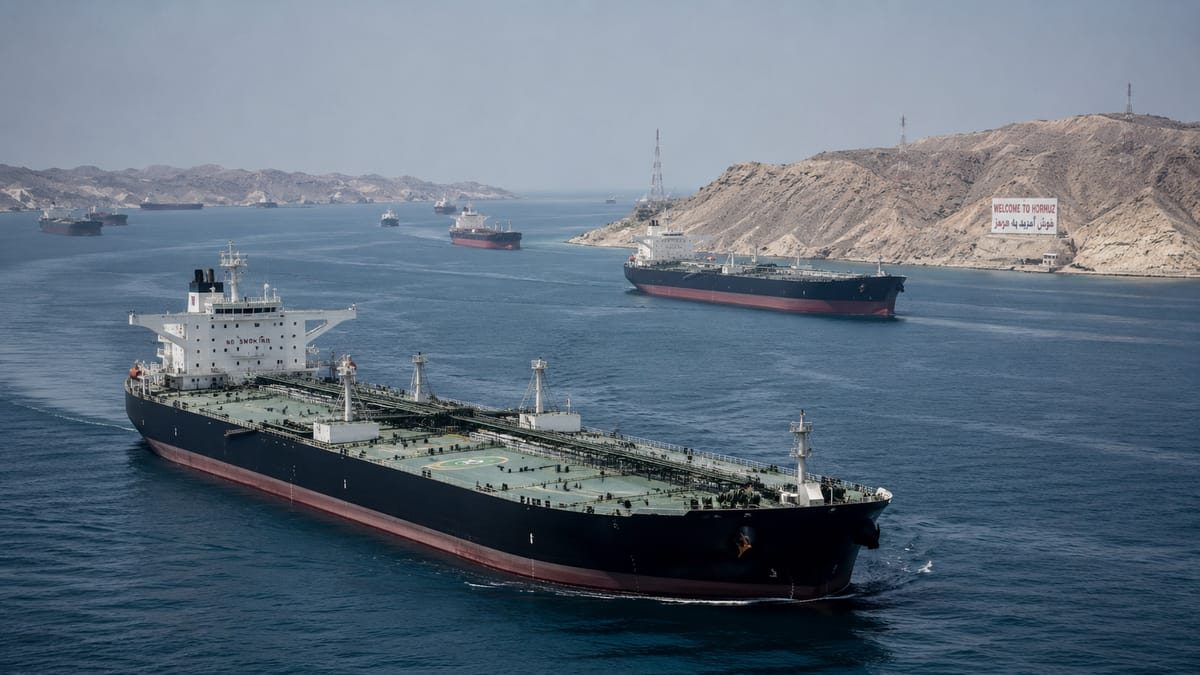
The Strait of Hormuz is a narrow passage between Iran and Oman, about 33 kilometres wide at its narrowest point. Around a fifth of the world's oil passes through it, along with large volumes of liquefied natural gas. It is the only sea route out of the Persian Gulf, which means oil from Saudi Arabia, Iraq, Kuwait, the United Arab Emirates, Qatar and Iran itself must pass through it to reach world markets.
Iran has long said it could close the strait in a conflict, and the United States has long said it would keep the strait open. That is why the strait has been at the centre of almost every crisis between the two countries, from the Tanker War of the 1980s to the present war.
The current war began in 2026, and by Gulf News' count it has now reached its 263rd day. The United States has tightened a naval blockade on Iran, warning that ships receiving Iranian cargo through ship-to-ship transfers could be stopped, boarded or seized, even if they never enter Iranian ports.
A timeline of shrinking offers
The two-hour offer is the latest in a pattern. Two months ago, Araghchi said Iran would open the strait only if seven preconditions were accepted. Days later, he said it could be opened in seven days. Earlier this month, he said two days. Now he says two hours.
Each step has shortened the time Iran says it needs, while the conditions have stayed largely the same: relief from sanctions, an end to the naval blockade, and guarantees that war will not resume. The shrinking timeline suggests Tehran wants to show flexibility, but the substance of the dispute has not moved.
What happens next
Three things will decide whether the two-hour offer leads anywhere. First, whether the United States accepts Iran's conditions, or offers its own. Trump has said Iran's terms are unacceptable, but talks through Qatar and Pakistan continue. Second, whether a deal can include guarantees against a return to war, which Araghchi has made a central demand. Third, whether the nuclear question can be separated from the strait, or whether Washington insists on dealing with both together.
For now, the strait remains the centre of the crisis. The two-hour offer is a sign that Tehran wants a deal. It is not yet a deal.
Frequently asked questions
What is Iran's two-hour plan for the Strait of Hormuz?
Iran's foreign minister, Abbas Araghchi, said on November 20 that Iran could reopen the Strait of Hormuz within two hours if the United States meets Iran's demands. He said the timetable does not matter, and what matters is that Iran's conditions are met.
What are Iran's conditions for reopening the strait?
According to Araghchi, Iran wants the lifting of new sanctions, an end to the US naval blockade, and guarantees that war will not resume. He also said Iran will not transfer its stockpile of 60 percent enriched uranium outside the country.
Is the Strait of Hormuz open now?
No. The strait remains closed to normal traffic, and no deal has been agreed. Iran says it is willing to reopen it quickly if its conditions are met, but the United States has not accepted those terms.
Why is the Strait of Hormuz so important?
Around a fifth of the world's oil passes through the strait, along with large volumes of liquefied natural gas. It is the only sea route out of the Persian Gulf, so a closure would disrupt oil supplies and raise fuel prices around the world.
How did the seven-day plan become a two-hour plan?
Iran first proposed a seven-day plan to reopen the strait, then shortened it to two days after talks with Qatar and Pakistan. On November 20, Araghchi said the timetable could be cut to two hours, as long as Iran's demands are met.