On Tuesday 17 November, the United States and Iran exchanged fire again, and by Wednesday morning the Gulf states were on alert. US fighter jets struck a missile site on Qeshm Island in the Strait of Hormuz, hours after Iran said it had targeted a US radar base in Bahrain. Bahrain said its air defences intercepted more Iranian attacks early on Wednesday, and Kuwait said it was countering hostile drone attacks. It is the latest turn in a war that began in late February and has now spread to the Gulf states that host US forces.
What happened on Tuesday
The day began with a claim from Iran. The Islamic Revolutionary Guard Corps (IRGC) said it had targeted a US radar system at Bahrain's Sheikh Isa Air Base. The Guards said the attack was a response to what they called violations of Iranian airspace by US military drones.
US Central Command (CENTCOM) said the Iranian one-way attack drones were intercepted, with no damage to US equipment and no injuries to American personnel.
Hours later, the United States struck back. A US military official, speaking on condition of anonymity, said US fighter jets used precision munitions to strike an IRGC missile launch site on Qeshm Island, in the Strait of Hormuz. The official described the strike as self-defence. "The strike was in response to IRGC aggression targeting US personnel and assets," the official said, adding that CENTCOM "remains highly vigilant and fully postured to protect Americans across the region."
Iranian media reported that an air-defence missile launcher in the Nariman area was targeted, and the IRGC-linked Tasnim agency said several projectiles struck the island. An Iranian provincial official, Ahmad Nafisi, said the attack caused no damage to residential or commercial areas or vital infrastructure. The extent of any damage to military facilities was unclear.
In a separate claim, Iran's army said it had shot down a LUCAS drone over the Strait of Hormuz. The United States has not commented on that claim.
Wednesday: Bahrain and Kuwait under attack
The exchange did not stop on Tuesday. Early on Wednesday 18 November, the General Command of the Bahrain Defence Force said its air defence systems had intercepted several Iranian air strikes aimed at the kingdom. It said the attacks were part of what it called a continuing, systematic Iranian campaign against Bahrain, and that its forces had responded with "strong will and high combat readiness."
It was the second attack in two days: Iran had launched drones early on Sunday at radar positions at Bahrain's Riffa Air Base, and Jordan, Egypt, Saudi Arabia and Qatar condemned it.
Kuwait also came under attack on Wednesday. Kuwait's military said its air defences were "responding to hostile drone threats" and urged the public to follow security and safety advice. Iran's army said on Wednesday, in a statement carried by state television IRIB, that its drones had targeted US military equipment, including Patriot missile systems, at Ali Al-Salem Air Base in Kuwait.
The Gulf Cooperation Council (GCC) condemned the attacks on Bahrain. Its Secretary General, Jasem Mohamed Albudaiwi, called on the international community, and the UN Security Council in particular, to take decisive measures to stop the attacks. "Any attack on the Kingdom constitutes an infringement on the security of all GCC states," he said.
Air travel is still disrupted, with flydubai and Etihad extending flight cancellations to Saudi cities into late November.
Why Qeshm Island matters
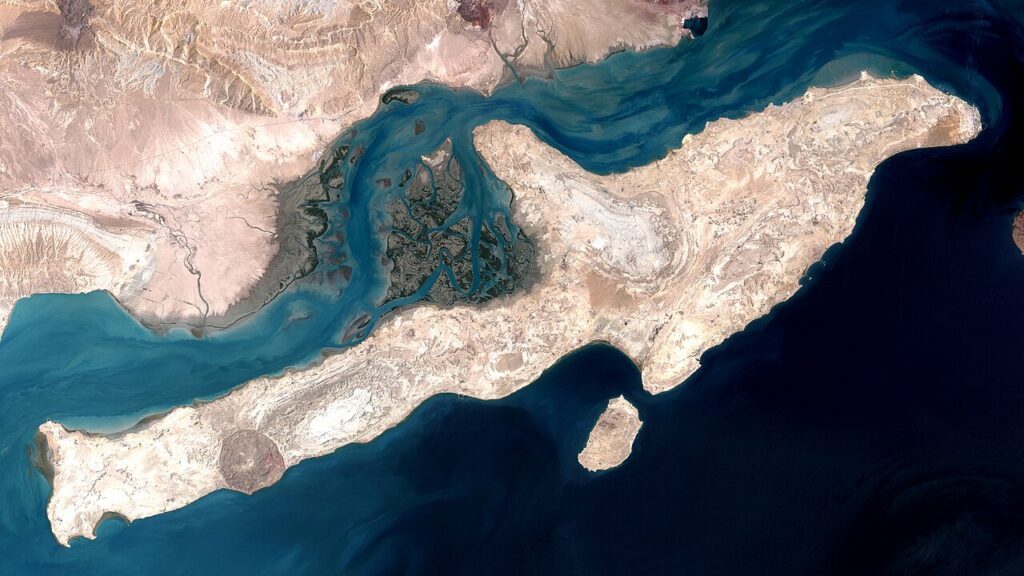
Qeshm Island is the largest island in the Persian Gulf. It sits at the mouth of the Strait of Hormuz, the narrow waterway between Iran and Oman through which oil tankers pass from the Gulf to the open sea. Before the war, about a fifth of the world's oil and liquefied natural gas passed through the strait, which Iran has now partly blocked, and attacks on tankers have increased this month.
Control of the strait is the centre of the war. The United States has been working to protect ships passing through the waterway, while Iran has tried to close it. On Tuesday, the US military released images showing two American aircraft carriers, the USS Theodore Roosevelt and the USS George Washington, sailing together in the Arabian Sea.
Bahrain hosts the headquarters of the US Navy's Fifth Fleet, and Kuwait's Ali Al-Salem Air Base is one of the largest US air bases in the region. By striking at Bahrain and Kuwait, Iran is putting pressure on the Gulf states that host American forces.
The wider war
The fighting on Tuesday and Wednesday is part of a war that has lasted nearly nine months. The war began on 28 February, when the United States and Israel launched strikes on Iran, and it has since fought in waves, with heavy fighting followed by lulls and talks.
The war has also spread to Yemen. On Wednesday, the Saudi-led Coalition to Support Legitimacy in Yemen said it had carried out strikes that destroyed 60 Houthi military targets in four Yemeni cities: Sanaa, Hodeidah, Saada and Amran.
At the same time, talks are still going on. Qatari and Iranian officials met on Tuesday for talks aimed at what a Qatari spokesperson called "bridging perspectives and narrowing the gap between proposals presented on the ground." Iranian Foreign Minister Abbas Araqchi was visiting Oman, and Iran's Foreign Ministry said on Monday that Tehran was reviewing the latest text from Washington, relayed through Pakistan, but urged a more "realistic" approach from President Trump.
President Trump said on Tuesday that he was "very seriously" taking reports that Iran was developing plans to use a so-called "dirty bomb" in Washington. Iran's Deputy Foreign Minister, Kazem Gharibabadi, rejected allegations in a CNN report that Tehran could be planning to use chemical weapons in a potential attack on Washington, calling them "a distortion of history."
The human and economic cost
The war has been costly. Benchmark Brent crude oil was trading at about $92.76 a barrel on Tuesday, much higher than before the war but well below the wartime peak of $126.41 reached in April. Energy prices, shipping costs and flight cancellations have affected people across the region.
Inside Iran, a near-total internet shutdown affecting more than 90 million people is now in its tenth week, imposed by the government for what it calls "security considerations."
The pattern of the last few days shows how hard this war is to end: both sides are still talking through mediators, and both sides are still shooting. Every new round of attacks makes a ceasefire harder to reach.
Frequently asked questions
What happened on Qeshm Island on 17 November 2026?
The United States said its fighter jets used precision munitions to strike an IRGC missile launch site on Qeshm Island, in the Strait of Hormuz. A US military official described the strike as self-defence, in response to Iranian attacks on US personnel and assets in Bahrain. Iranian officials said the attack caused no damage to residential areas or vital infrastructure.
Why did the US strike Qeshm Island?
The US said it was a response to Iran targeting a US radar system at Bahrain's Sheikh Isa Air Base earlier on Tuesday. Iran said its attack on Bahrain was a response to what it called violations of Iranian airspace by US military drones.
Which Gulf states were attacked on 18 November?
Bahrain said its air defences intercepted several Iranian air strikes early on Wednesday, the second attack in two days. Kuwait said its air defences were countering hostile drones, and Iran's army said its drones had targeted US Patriot systems at Ali Al-Salem Air Base.
Why is the Strait of Hormuz so important?
The Strait of Hormuz is the narrow waterway between Iran and Oman that connects the Persian Gulf to the open sea. Before the war, about a fifth of the world's oil and liquefied natural gas passed through it. Whoever controls the strait can affect global energy supplies, which is why it is at the centre of the conflict.
Are the US and Iran still talking?
Yes. Qatari and Iranian officials met on Tuesday, Iran's Foreign Minister was visiting Oman, and Iran said it was reviewing the latest text from Washington, relayed through Pakistan. The talks have not stopped the fighting, but they are still going on.