Baghdad is one of the most famous cities in history. For five hundred years it was the capital of the Muslim world, a centre of trade, learning and science. The man who founded it was the caliph Al-Mansur, the second ruler of the Abbasid dynasty. He was not the most famous caliph, and he did not have the glamour of his grandson Harun al-Rashid. But without Al-Mansur there would have been no Baghdad, and without Baghdad the golden age of Islam would have looked very different. This is the story of who he was and what he built.
From revolution to the throne
Al-Mansur was born around 714, with the full name Abu Ja'far Abdallah ibn Muhammad. He belonged to the Abbasid family, who claimed descent from Abbas, an uncle of the Prophet Muhammad. When Al-Mansur was a young man, the Abbasids were leading a secret movement to overthrow the Umayyad dynasty, which had ruled the Muslim world from Damascus for nearly a hundred years.
The Abbasid revolution succeeded in 750. The Umayyads were overthrown, and Al-Mansur's elder brother, Abu al-Abbas al-Saffah, became the first Abbasid caliph. Al-Mansur was his brother's closest helper. He led armies, crushed Umayyad loyalists, and helped build the new government. When al-Saffah died in 754, only four years after taking the throne, Al-Mansur became the second Abbasid caliph. He ruled for twenty-one years, from 754 to 775, and his reign decided whether the new dynasty would survive or fall apart.
The caliph who saved the Abbasid state
Al-Mansur took power at a dangerous time. The new dynasty had many enemies, including members of its own family. In the first year of his reign, his uncle Abdullah ibn Ali, a powerful general who had helped win the revolution, rebelled and claimed the throne for himself. Al-Mansur defeated him in battle and removed him from power.
Then came other revolts. The Alids, the descendants of Ali ibn Abi Talib, believed they had a better claim to rule than the Abbasids. In 762, Muhammad al-Nafs al-Zakiyya, an Alid leader, rose in revolt in Medina, and his brother Ibrahim rose in Basra. Al-Mansur's armies crushed both revolts, and both brothers were killed.
Al-Mansur earned his title from these victories. Al-Mansur means "the Victorious" in Arabic, and it was a title he took for himself. But he was not only a soldier. He was careful, patient and very good with money. He kept a close eye on the treasury, checked the accounts himself, and was known for spending little on himself. People at his court said he counted every coin. This careful management gave the Abbasid state the money it needed to build a capital and an empire.
Why he built a new capital
The first Abbasid capital was not Baghdad. After the revolution, al-Saffah had ruled from al-Hashimiyya, a town in Iraq near Kufa. Al-Mansur also used Kufa and other towns at first. But none of them suited him. Kufa was full of Alid supporters and old political rivalries. He wanted a new city, built by him, loyal to him, and placed where he could control the trade and the armies of the empire.
In 762, the same year as the Alid revolts, he chose a site on the west bank of the Tigris River, near the ruins of the old Sasanian capital, Ctesiphon. The place had two great advantages. The Tigris and the Euphrates rivers met nearby, so goods could reach the city by water from the Persian Gulf, from Syria and from the north. And it sat in the middle of Iraq, the richest farmland in the Muslim world. He called the new city Madinat al-Salam, the City of Peace. The world would come to know it simply as Baghdad, the name of a small village that had stood on the site.
The Round City
Baghdad was built in a shape no other great city had used before. It was a perfect circle, about two kilometres across, with double walls and a moat. Four gates pointed in the four directions, towards Kufa, Basra, Khurasan and Syria. At the very centre stood the caliph's palace, the Palace of the Golden Gate, and beside it the great mosque. The caliph lived at the centre of his city, just as he stood at the centre of the empire.
Building it took about four years, from 762 to 766. Al-Mansur brought in workers, engineers, surveyors and craftsmen from across the empire. The old histories say around one hundred thousand workers took part, though the real number may have been smaller. The cost was huge, and Al-Mansur watched the spending closely, counting the bricks and the wages himself, as the stories tell it. He also built a second city, al-Rusafa, on the east bank of the river, for his son and heir, al-Mahdi.
The design was not only for show. A round wall is shorter than a square wall around the same area, so it needed fewer soldiers to defend. The gates could be closed quickly, and the streets led straight to the centre, so troops could move fast. The city was a fortress and a capital in one.
Baghdad becomes the centre of the world
Al-Mansur moved his court to Baghdad in 766, and the city grew fast. Traders came from India, China, Africa and Europe. Ships sailed up the Tigris from the Persian Gulf, bringing spices, silk, timber and gold. Markets filled the streets, and craftsmen set up workshops for paper, glass, metal and cloth. Within a few decades Baghdad was the largest city in the world, with a population that may have reached one million people.
The city Al-Mansur built also became the home of learning. Under his grandson Harun al-Rashid and his great-grandson al-Mamun, the House of Wisdom gathered scholars who translated Greek, Persian and Indian books into Arabic, and made advances in medicine, astronomy, mathematics and philosophy.
Al-Mansur also built the government that ran the empire. He kept the postal and intelligence service, the barid, which carried his orders across the empire and reported back on what his governors were doing. He brought Persian officials into the administration, including the Barmakid family, who would become the most powerful ministers of the next generation.
His character and his death
Al-Mansur was not a warm or popular ruler. He was stern, suspicious and quick to remove anyone he thought was a threat, even his own helpers. He had his most famous general, Abu Muslim, the man who had won the revolution for the Abbasids, killed in 755, because he feared Abu Muslim had grown too powerful. He treated his ministers the same way. But he was also honest about his duty. He worked long hours, read the reports himself, and took the business of ruling seriously.
He died in 775, while on the pilgrimage to Mecca, at about sixty years of age. By his own order, his grave was not marked, so that no one would know exactly where he was buried. His son al-Mahdi succeeded him peacefully, which was itself a sign of how strong the state had become. Al-Mansur had taken a new dynasty that might have fallen in its first years, and left behind a stable empire with a capital city that would last for five centuries.
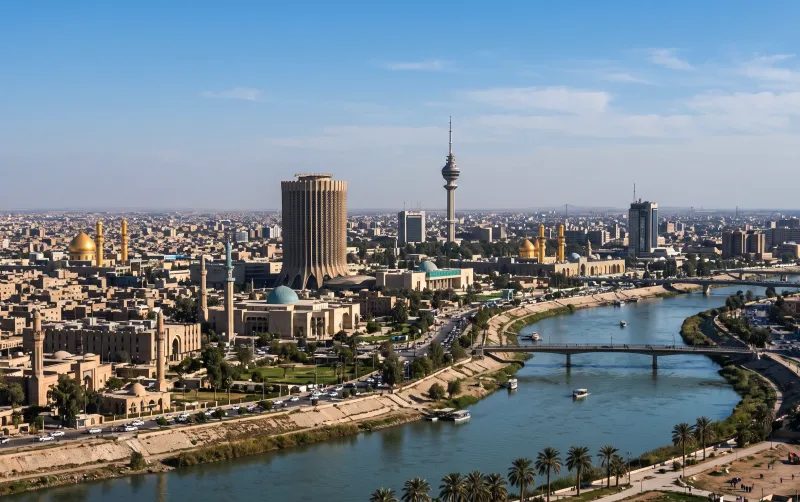
Today, the Round City he built is gone, destroyed and rebuilt many times over the centuries. But the city itself remains. Baghdad still stands on the Tigris, on the ground Al-Mansur chose in 762, and it still carries the name of the city he founded.
Frequently asked questions
Who was Al-Mansur?
Al-Mansur, whose full name was Abu Ja'far Abdallah ibn Muhammad, was the second Abbasid caliph. He ruled from 754 to 775 and is remembered as the real founder of the Abbasid state and the founder of Baghdad.
When did Al-Mansur found Baghdad?
Al-Mansur founded Baghdad in 762. He called it Madinat al-Salam, the City of Peace. The building of the Round City took about four years, from 762 to 766, and he moved his court there in 766.
Why did Al-Mansur build Baghdad in a circle?
Baghdad was built as a circle with double walls, four gates and the caliph's palace at the centre. A round wall is shorter than a square wall around the same area, so it needed fewer soldiers to defend, and the straight streets let troops move quickly to any gate.
What does Al-Mansur mean?
Al-Mansur means "the Victorious" in Arabic. He took the title after his victories over rivals and rebels in the early years of his reign, including his uncle Abdullah ibn Ali and the Alid revolts of 762.
How long did Al-Mansur rule?
Al-Mansur ruled for twenty-one years, from 754 until his death in 775. He died while on the pilgrimage to Mecca and was succeeded by his son al-Mahdi.