Timur, known in the West as Tamerlane, was one of the most feared conquerors in history. He was born in 1336 near Samarkand, in what is now Uzbekistan, and died in 1405 while marching to invade China. In thirty five years of almost constant war, he conquered Persia, Iraq, Syria, and northern India, defeated the Ottoman sultan in battle, and built an empire that stretched from Turkey to the borders of China. He was also a great builder and patron of art who turned his capital, Samarkand, into one of the most beautiful cities of the medieval world. His name is still remembered with fear in some places and with pride in others, and his descendants went on to found the Mughal Empire in India.
Origins and the name Tamerlane
Timur was born in the town of Kesh, south of Samarkand, in the region the Muslims called Transoxiana, the land beyond the Oxus River. His family belonged to the Barlas tribe, a Turkic tribe that claimed descent from the Mongols. He grew up in the world left behind by Genghis Khan, whose empire had broken into smaller states a century earlier. Timur spoke a Turkic language, and he also knew Persian, the language of culture and government in the region.
The name Tamerlane comes from Timur-i Lang, which means Timur the Lame. He was wounded in his youth, probably in a battle or a raid, and he walked with a limp and had an injured right hand for the rest of his life. The injury never stopped him from riding or from leading armies in person. In the West, his name was turned into Tamerlane, and it became a byword for a ruthless conqueror.
Timur never called himself a khan, a title that belonged to the descendants of Genghis Khan. He married into that family and ruled through puppet khans, while holding all the power himself.
The rise to power
In his youth, Timur was a minor chief leading raids and small wars among the tribes of Transoxiana. The region was divided between rival rulers, and Timur moved between them, building a following of loyal soldiers. He formed alliances, broke them when it suited him, and rewarded his men with a share of the loot from every campaign.
By 1370, at the age of thirty four, he had taken control of Transoxiana and made Samarkand his capital. From that base, he began the conquests that would fill the rest of his life. His empire was built by his army, and it was held together by his presence and his fearsome reputation. Whenever he left a region, he left a governor behind, but the real power stayed with his moving court and his soldiers.
The conquest of Persia and the Middle East
Timur's first great campaigns were in Persia. Between 1380 and 1387, he took Herat, Shiraz, and Isfahan, and brought the whole of Persia under his rule. His treatment of cities that resisted him was brutal. When Isfahan rebelled after surrendering, his soldiers massacred tens of thousands of its people. Cities that surrendered without a fight were usually spared, and this was part of his method. The choice was clear, and it was meant to be.
In 1393, he took Baghdad, and in 1401 he took it again after a revolt. In 1400 and 1401, he marched into Syria and took Aleppo and Damascus. Damascus, one of the great cities of the Muslim world, was plundered, and its craftsmen were carried off to Samarkand to work on his buildings. These campaigns made him the master of the heartland of the Muslim world, but they also left a trail of ruined cities behind him.
The sack of Delhi
In 1398, Timur turned east and invaded India. His target was the Sultanate of Delhi, a rich Muslim state ruled by a sultan whose power had weakened. Timur crossed the Indus River, defeated the sultan's forces outside Delhi, and entered the city. For several days, his soldiers looted the city and killed large numbers of its people. The sack of Delhi is remembered as one of the worst disasters in the history of India, and it weakened the Delhi Sultanate so badly that it never fully recovered.
Timur did not stay in India. He took the treasure of Delhi and its craftsmen back to Samarkand, and he left India behind. He had no interest in ruling it himself. Like many of his campaigns, the invasion was about plunder and prestige rather than building a lasting state.
The Battle of Ankara
Timur's most famous victory came in the west, against the Ottoman Empire. The Ottoman sultan Bayezid I had conquered much of the Balkans and was besieging Constantinople. He and Timur quarrelled over territory in eastern Anatolia, and both men sent insulting letters to each other. In 1402, their armies met near Ankara, in modern Turkey.
The Battle of Ankara was a disaster for the Ottomans. Timur's army was larger, and several of Bayezid's allies and soldiers changed sides during the battle. Bayezid himself was captured and died in captivity the next year. The Ottoman Empire fell into a civil war between Bayezid's sons that lasted for eleven years. The defeat delayed the Ottoman conquest of Constantinople by half a century, and it is one of the great turning points of history. Constantinople would not fall to the Ottomans until 1453.
Timur did not follow up his victory by taking Ottoman land. After Ankara, he turned back east, and the Ottomans were left to rebuild. This was typical of him. He conquered, took the wealth, and moved on.
Samarkand, the city he built
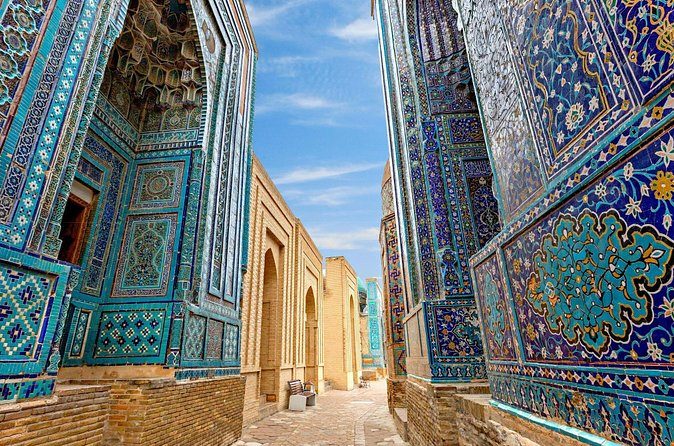
For all his destruction, Timur was also a great builder. He poured the wealth of his conquests into Samarkand, his capital, bringing the finest craftsmen from the cities he had taken to work on mosques, madrasas, and tombs. The Bibi-Khanym Mosque was one of the largest mosques in the world, and the Gur-e Amir mausoleum, where he is buried, is covered in blue tiles and gold.
Timur's building programme created a new style of art and architecture, called Timurid, which mixed Persian, Turkic, and Mongol influences. Its domes, tiles, and calligraphy spread across Central Asia and into India, where his descendants used the same style to build the Taj Mahal. His grandson Ulugh Beg, who ruled Samarkand after him, built one of the great observatories of the medieval world.
Death and legacy
In 1405, at the age of about sixty nine, Timur set out on his last campaign, an invasion of Ming China. He reached the town of Otrar, in modern Kazakhstan, where he fell ill and died. His body was taken back to Samarkand and buried in the Gur-e Amir mausoleum, under a great slab of dark green jade.
His empire did not survive him. His sons and grandsons fought over it, and within a few decades it had broken into smaller states. But his family kept its prestige. In 1526, his descendant Babur founded the Mughal Empire in India, which lasted for more than three centuries. The Mughals proudly traced their line back to Timur.
Historians still argue about Timur. He was one of the bloodiest conquerors in history, and his campaigns killed vast numbers of people and destroyed some of the great cities of the Muslim world. Yet he also rebuilt Samarkand into a centre of learning and art, and his descendants shaped the history of India for centuries. He is remembered in Uzbekistan as a national hero. In Persia, Syria, and India, his name is remembered with horror. Both memories are true, and that is why he remains one of the most debated figures in history.
Frequently asked questions
Who was Timur, also known as Tamerlane?
Timur was a Turco-Mongol conqueror born in 1336 near Samarkand. He built an empire stretching from Turkey to the borders of China and defeated the Ottoman sultan at the Battle of Ankara in 1402.
Why is Timur called Tamerlane?
Tamerlane comes from Timur-i Lang, meaning Timur the Lame. He was wounded in his youth and walked with a limp for the rest of his life, though the injury never stopped him from leading armies.
What did Timur conquer?
He conquered Persia, Iraq, Syria, and northern India, including the sack of Delhi in 1398. He defeated the Ottoman Sultan Bayezid I at Ankara in 1402 and took Baghdad, Aleppo, and Damascus.
What did Timur build in Samarkand?
He built the Bibi-Khanym Mosque and the Gur-e Amir mausoleum where he is buried. His building programme created the Timurid style of architecture that later shaped the Taj Mahal.
How is Timur related to the Mughal Empire?
His descendant Babur founded the Mughal Empire in India in 1526. The Mughals traced their line back to Timur, and the name Mughal itself comes from Mongol, the tradition Timur belonged to.